


If you’re trying to manage local SEO for a business with multiple locations, a one-size-fits-all strategy just won’t cut it. You have to treat each storefront as its own unique entity, creating a distinct digital presence for every single one while still keeping your brand identity solid. This means building out dedicated pages on your website for each location and making sure your business info is perfectly consistent across the web.
Why a Generic SEO Strategy Fails Multiple Locations
Applying a single SEO strategy across multiple locations is like handing every customer the same map, no matter where they are. It’s a fast track to getting them lost. Each of your physical stores exists in its own community, with its own local competitors, search trends, and customer quirks. A generic approach completely misses these critical details, making it almost impossible to rank well in different cities.
Multi-location SEO is all about optimizing each individual business location so it can climb the local search rankings, all while maintaining that cohesive brand feel. And with a massive 46% of all Google searches having local intent, you can’t afford to ignore this. Treating each location as its own distinct operation is the only way to make sure your San Diego branch pops up for “coffee shop in San Diego” while your Boston spot appears for “best espresso in Boston.” It’s that simple.
Building Your Website for Local Success
Your website’s structure is the foundation of any good multi-location SEO plan. You absolutely need a dedicated, fully optimized landing page for every physical location you operate. These can’t just be cookie-cutter pages with the city name swapped out; they need to function as unique digital storefronts.
Each location page has to include:
- Unique Local Content: Talk about nearby landmarks, mention local events your store is involved in, or feature team members from that specific branch. This sends strong signals to Google that your page is genuinely relevant to that community.
- Specific Business Information: Make sure the Name, Address, and Phone Number (NAP) are correct and clearly displayed. Don’t forget store hours and an embedded Google Map for that exact spot.
- Localized On-Page SEO: This is where you fine-tune your title tags, meta descriptions, and headers with location-specific keywords (e.g., “Boutique Clothing in Portland, Oregon”). Our guide on on-page SEO digs much deeper into getting these elements right.
Key Takeaway: Think of each location page as a micro-website for that branch. Its job is to serve the local customer with hyper-relevant info that a generic corporate page just can’t deliver.
The Critical Role of NAP Consistency
Once your location pages are set up, the next piece of the puzzle is locking down your Name, Address, and Phone number (NAP) consistency. It has to be identical everywhere online. Inconsistent information creates confusion for both search engines and potential customers, which can seriously tank your local rankings.
For instance, if your Google Business Profile says “123 Main St.” but Yelp has it as “123 Main Street,” that small difference is a red flag. Google’s algorithm is all about trust, and consistency is a huge signal of trustworthiness. You need a single, undisputed source of truth for each location’s data. That means every single directory, social profile, and online mention has to match what’s on its location page—perfectly. Getting this right from the start saves a ton of headaches later and builds the authority you need to scale across all your branches.
Before we dive into citations, let’s talk about the tools that make managing all of this possible. You can’t just wing it when you’re juggling multiple locations.
Essential Tools for Managing Multi-Location SEO
To effectively manage SEO across multiple locations, you need a solid tech stack. These tools help automate tedious tasks, track performance accurately, and ensure consistency at scale. Think of them as your multi-location command center.
Here’s a breakdown of the key tools that can make a world of difference.
| Tool Category | Primary Function | Popular Examples |
|---|---|---|
| Local Listing Management | Distribute & sync NAP data across directories | Yext, Moz Local, BrightLocal |
| Rank Tracking | Monitor keyword rankings in specific zip codes | SEMrush, Ahrefs, Whitespark |
| Review Management | Aggregate & respond to customer reviews | Podium, BirdEye, GatherUp |
| Analytics & Reporting | Track website traffic, user behavior, & conversions | Google Analytics 4, Google Search Console |
Choosing the right combination of these tools will give you the control and insight needed to manage your locations efficiently. Without them, you’re essentially flying blind, making it nearly impossible to scale your efforts or prove your ROI.
Mastering Google Business Profile for Each Location

Think of your Google Business Profile (GBP) as the digital front door for each of your locations. For multi-location businesses, this isn’t a single profile but a collection of unique, hyper-local listings that each demand individual attention.
Let’s be clear: a well-managed GBP for every branch is non-negotiable for anyone serious about local SEO for multiple locations.
The importance of these profiles has skyrocketed. Consumer behavior has shifted dramatically, with “near me” searches surging by more than 900% in recent years. On top of that, 99% of consumers use the internet to find local businesses, and a fully completed GBP makes a business seem 2.7 times more trustworthy.
The data paints a clear picture—your GBP is where local customers first meet your brand. You can explore more revealing local search statistics on seoprofy.com.
Setting Up Individual Profiles Correctly
First things first: you need a separate GBP for every single physical address. This is a core part of Google’s guidelines, and it’s what allows you to tailor information specifically for that community.
Resist the temptation to use a central office number for all your listings. Each profile needs the direct, local phone number for that specific branch. It’s a small detail that makes a huge difference.
Consistency with your business name is just as crucial. Your brand name should be identical across all listings—for example, “Visibility Ventures,” not “Visibility Ventures – Seattle.” Slapping location identifiers onto your business name is a common mistake, and it’s a fast track to getting your listings penalized.
Optimizing Categories and Services
Choosing the right categories is one of the most impactful optimizations you can make. Your primary category should describe the core service of your business. If you run a coffee shop chain, “Coffee shop” is your primary category for every single location. Simple as that.
Secondary categories, however, are where you can really start to differentiate. Let’s say your Portland location has a large event space. For that profile only, you could add “Event venue” as a secondary category. This level of detail helps you show up in more specific, long-tail local searches like “coffee shop with meeting rooms near me.”
Expert Tip: Don’t go overboard with categories. Pick a few highly relevant ones that accurately reflect what each location offers. Precision is far more effective than casting a wide, generic net.
Leveraging Visuals and Google Posts
Each of your locations has its own vibe, and there’s no better way to show it off than with location-specific photos. Use high-quality images of the storefront, the interior, and your local team. This visual proof helps customers recognize the store and builds a sense of familiarity before they even walk in.
Google Posts are another powerful, and often underused, tool for local engagement. Think of them as mini-ads or social media updates that appear directly on your GBP. You can use them to:
- Announce local events: “Join our Austin branch for a free tasting event this Saturday!”
- Share location-specific offers: “Get 20% off all pastries at our Brooklyn location this week only.”
- Highlight new products or services: “Our new seasonal menu just dropped at the Denver store.”
These posts expire after seven days, so they do require active management. But they also provide a direct line of communication with local searchers, keeping your profile fresh and engaging. This active management is a crucial part of a comprehensive local SEO services strategy designed to maximize visibility.
Dominating the Google Maps 3-Pack
The ultimate goal here is to land a spot in the Google Maps “3-Pack”—the top three local results that pop up for a search. There’s no magic button to press, but a fully optimized GBP is the price of admission.
Ranking in the 3-Pack comes down to three main factors: relevance, distance, and prominence. Your GBP optimization directly influences relevance and prominence. By choosing the right categories, filling out every section, and encouraging reviews for each location, you send strong signals to Google that your business is a relevant and prominent answer to what someone is searching for.
Applying this detailed approach, consistently, across every single one of your locations, is the key to turning local searches into real-world customers.
Scaling Your Citation and Review Management
Beyond your website and Google Business Profiles, your brand’s presence spreads across a huge network of online directories, apps, and platforms. These mentions are called citations, and they act as critical trust signals for search engines. Managing them for one location is a chore. Scaling it across multiple branches? That’s a whole different ballgame and requires a solid strategy.
At its core, a citation is any online mention of your business’s Name, Address, and Phone number (NAP). Getting this information perfectly accurate across every single listing—from Yelp and Bing to niche industry directories—is non-negotiable. Even a tiny inconsistency, like using “St.” on one site and “Street” on another, can muddy the waters for Google’s algorithm and hurt your local rankings.
Manual vs. Automated Citation Management
You’re going to face a key decision: handle these listings by hand or use a service? Let me be blunt: for any business with more than a handful of locations, manual management is a recipe for disaster. The sheer number of directories makes tracking and updating everything an endless, error-prone headache.
This is where citation management tools are a lifesaver. Services like BrightLocal or Moz Local act as a single source of truth, pushing your correct NAP data out to dozens of directories all at once. It saves a staggering amount of time and guarantees the consistency that search engines crave. Yes, there’s a cost, but the ROI from saved labor and improved accuracy is a no-brainer.
Choosing the right approach depends on your scale and resources. Let’s break down the two options.
Manual vs. Automated Citation Management
| Feature | Manual Management | Automated Management (Using Tools) |
|---|---|---|
| Cost | Free (but high labor cost) | Monthly/Annual subscription fee |
| Time Investment | Extremely high; an ongoing task | Minimal after initial setup |
| Scalability | Very difficult to scale beyond a few locations | Highly scalable for hundreds of locations |
| Accuracy | Prone to human error and inconsistencies | Ensures consistent data across all listings |
| Reporting | No centralized reporting; difficult to track | Centralized dashboard for easy monitoring |
| Best For | Businesses with 1-2 locations and a tight budget | Multi-location businesses and franchises |
While manual management might seem tempting for saving money, the hidden costs in time and potential errors often outweigh the benefits for any growing business. Automation provides the consistency and scale needed to compete effectively.
The infographic below really drives home how a well-built landing page for each location should be the anchor for all your local data.
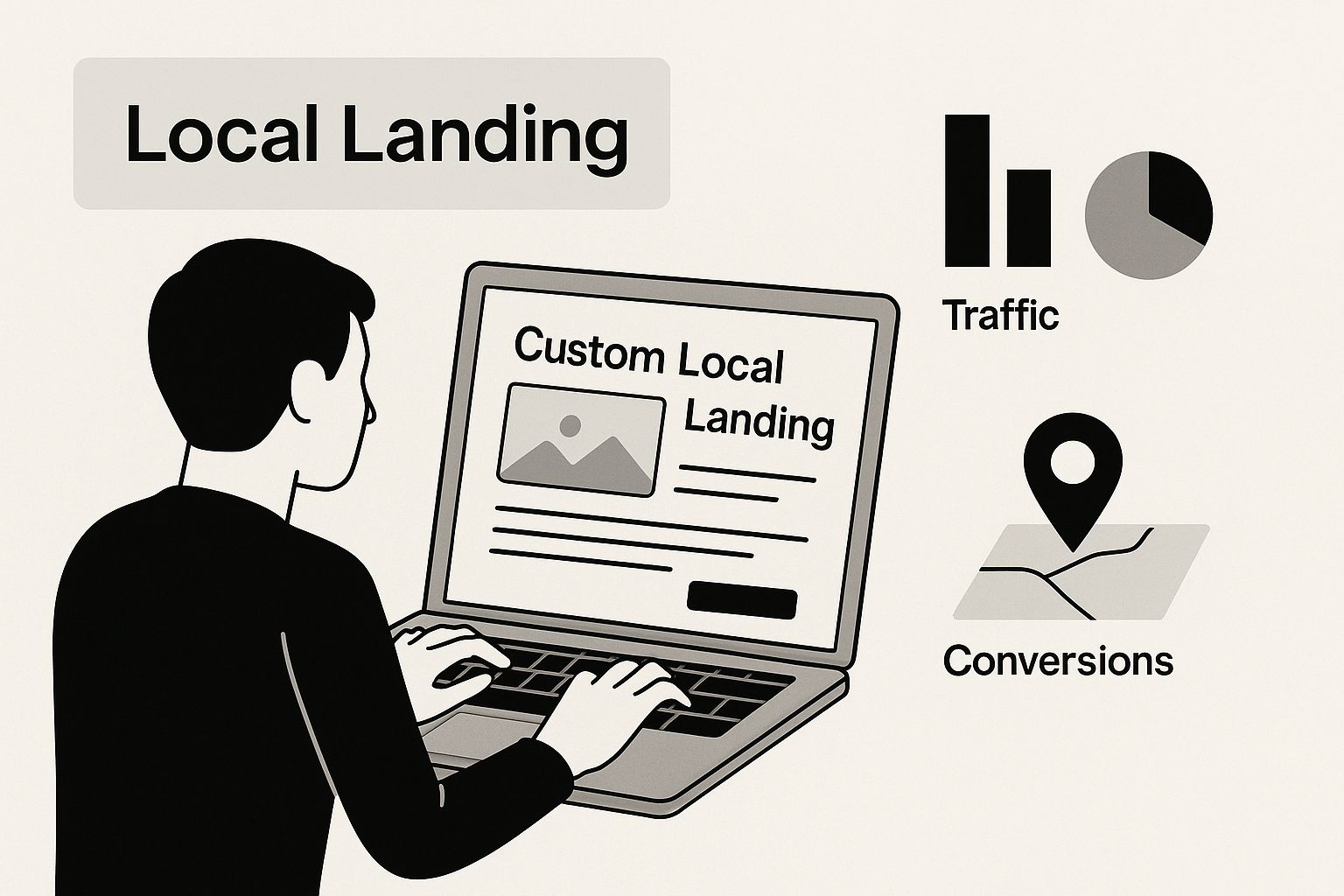
This visual shows why having a dedicated, optimized page for each location is so important—it becomes the single source of truth that your entire citation strategy is built on.
Building a Scalable Review Generation System
Citations build foundational trust with Google, but it’s reviews that build trust with actual customers. A steady flow of recent, positive reviews is easily one of the most powerful local ranking factors. For a multi-location brand, this process has to be systematic.
The goal isn’t just to get more reviews, but to make sure they’re left for the right location. This is all about empowering your local teams and using simple, automated systems.
Here’s how we typically set this up:
- Automate the Ask. Implement a simple system that triggers a review request via email or SMS shortly after a customer makes a purchase or has an appointment.
- Create Direct Links. Give each location a unique, shortened link that goes straight to their “Leave a Review” page on Google. This removes any friction for the customer.
- Empower Local Staff. Train your on-the-ground teams to ask for feedback. A simple, “If you had a great experience today, we’d love to hear about it on Google,” can work wonders.
Responding to reviews is just as important as getting them in the first place. A prompt, personal response to both good and bad feedback shows you’re listening and can improve local rankings by as much as 15%.
Managing Reputation Across All Branches
A strong local reputation is built on two things: a consistent customer experience and active online engagement. This is especially true for national brands that need to feel like a neighborhood business. For businesses in hyper-competitive fields like the restaurant industry, learning the subtleties of a local approach is make-or-break. We dive deep into these strategies in our guide to food chain SEO, which has lessons for any multi-location company.
The final piece of this puzzle is monitoring. Use a reputation management tool to pull all your reviews from every location into a single dashboard. This gives your central marketing team a bird’s-eye view to spot trends, identify underperforming branches, and ensure brand standards are being upheld everywhere.
By combining automated citation management with a proactive review strategy, you create a powerful, scalable system that drives visibility and builds real customer loyalty across all your locations.
Creating Hyper-Local Content That Connects
Let’s be blunt: generic, corporate-style content just doesn’t fly with local audiences. If you want to win at local SEO across multiple locations, you have to create content that speaks directly to the communities each of your branches serves. This is about turning your location pages from simple address listings into genuine, hyper-local hubs.
Think of it this way: a national brand feels distant, but a local business feels like a neighbor. Your content is what closes that gap. When you feature local stories, highlight your staff, and share neighborhood-specific tips, you’re telling both Google and your future customers that you’re a real part of the community.
Go Beyond a Simple Address Listing
Your location pages are the most valuable digital real estate you have for local SEO. They need to be unique, rich with detail, and genuinely helpful to someone in that specific area. Stop thinking of them as just a place to stick a map and start treating them like mini-websites for each branch.
To make these pages truly powerful, here’s what to include:
- Neighborhood-Specific Details: Mention nearby landmarks, cross-streets, or popular local spots. Instead of just “Our Chicago Store,” try something like, “Find our West Loop store just a block away from Restaurant Row.” It’s a small change that makes a huge difference.
- Local Testimonials and Reviews: Pull out reviews from customers who specifically mention that location. This kind of social proof is incredibly effective for building trust with new local customers.
- Meet the Local Team: Feature photos and short bios of the store manager or key team members. Putting a face to the business makes a huge national brand feel much more personal and approachable.
- Location-Specific FAQs: Answer questions that are unique to that branch. Think about things like parking, public transit access, or special services offered only at that spot.
Develop a Hyper-Local Content Marketing Strategy
Beyond your core location pages, a localized content marketing strategy is what will really set you apart. This means creating blog posts, guides, and resources centered around the communities you serve. This approach doesn’t just provide value to local readers; it creates powerful ranking signals for location-based searches.
A strong content strategy is a cornerstone of any effective digital marketing effort, helping you attract and engage your target audience. Discover how to build a robust framework with our insights on content marketing services.
Key Takeaway: Hyper-local content isn’t just an SEO play; it’s about community building. When you create something that solves a local problem or highlights a local interest, you forge a real connection that turns searchers into loyal customers.
The game is always changing, and today’s local SEO landscape is no different. We’re seeing AI-driven content helping multi-location brands scale their visibility—in fact, 92% of local SEO professionals are now using AI tools to generate helpful, localized content. At the same time, Google Maps has seen a massive 100% year-over-year increase in “shopping near me” searches, proving just how much people rely on map-based local searches.
Practical Ideas for Localized Blog Content
Stuck for ideas? Here are a few real-world examples you can adapt for your own business:
- A restaurant chain in Austin: “Our Guide to the Best Pre-Show Dinner Spots in Austin’s Theater District”
- A hardware store in Denver: “A Seasonal Lawn Care Calendar for Denver Homeowners”
- A retail boutique in Portland: “Partnering with Portland Artisans: A Look at Our Favorite Local Designers”
- A fitness center in Miami: “The Top 5 Running Trails Near Our South Beach Gym”
This screenshot from Wikipedia defines “Hyperlocal” as information focused on a well-defined community, with its primary focus on the concerns of its residents.

That definition gets to the heart of it: your content has to address the specific interests and needs of the local audience you’re trying to reach.
When you consistently produce this kind of content, you build a library of resources that positions each of your locations as a local authority. This does more than just attract organic traffic from super-relevant local searches—it builds a level of trust and brand loyalty that a generic, nationwide content strategy could never hope to achieve. It’s all about showing up and being a valuable part of the neighborhood, both online and off.
Measuring Performance and Proving Local SEO ROI
You’ve poured a ton of time and resources into your multi-location SEO strategy. That’s great. But if you can’t measure the impact, you’re essentially flying blind. Proving the return on your investment isn’t just about creating pretty reports to show the higher-ups; it’s about making smarter decisions, figuring out what’s actually working in each market, and justifying the budget to keep the momentum going.
A solid measurement plan connects your online efforts directly to what’s happening in the real world. This means getting past vanity metrics and zeroing in on the key performance indicators (KPIs) that actually reflect the health and growth of each individual location.
Pinpointing the KPIs That Actually Matter
For any business with more than one location, performance tracking has to be granular. A single, rolled-up report is useless—it won’t tell you that your Dallas store is crushing it while your Denver branch is struggling. You have to segment your data by location to get insights you can actually use.
Here are the essential KPIs you should be watching for every single branch:
- Local Organic Traffic: Jump into Google Analytics and filter traffic down to each specific location page. A steady climb here is a good sign that your on-page SEO and content are hitting the mark.
- Location-Specific Keyword Rankings: You need to track rankings for keywords like “[your service] in [city]” for every location. This shows you exactly how visible you are in the local searches that drive business.
- Google Business Profile Interactions: This is where the magic happens for local. Keep a close eye on the metrics inside each GBP listing, like clicks to call, direction requests, and website clicks. These are high-intent actions from people ready to become customers.
- Local Pack Visibility: How often is each location showing up in the Google Maps 3-Pack for your most important keywords? More visibility here is a direct result of strong GBP optimization and a healthy stream of positive reviews.
Key Insight: Don’t just look at the numbers; watch the trends. A sudden dive in direction requests for one location might point to a problem with its GBP listing. On the flip side, a spike in calls for another could be tied to a recent Google Post campaign that really resonated.
Using the Right Tools for Location-Based Tracking
To get this kind of detailed view, you need to set up your analytics tools the right way. Google Analytics 4 (GA4) and Google Search Console (GSC) are non-negotiable for tracking local SEO for multiple locations effectively.
In Google Analytics 4, you can create custom reports or use “Comparisons” to isolate data based on specific landing pages. For instance, you can build a report that only shows traffic, conversions, and user behavior for your /locations/seattle page. This tells you exactly how people in that area are interacting with your website.
Google Search Console is a goldmine for understanding the search queries that bring people to each location page. By filtering your performance report by page URL, you can see the exact local keywords people are using to find your Boston branch versus your Miami branch. This data is invaluable for fine-tuning your hyper-local content strategy.
Connecting Online Efforts to Offline Revenue
Ultimately, the goal is to prove that your SEO work is putting money in the bank. This means connecting digital metrics to tangible business outcomes—a process that is incredibly powerful for demonstrating value.
Think about it this way: by tracking the number of direction requests from each Google Business Profile listing, you can start to estimate foot traffic. If you know the average in-store conversion rate and the average sale amount for that specific branch, you can begin to assign a real dollar value to your local SEO efforts.
This data-driven approach shows you which locations are thriving and which might need a little extra help. It transforms abstract ideas like “visibility” into concrete results that resonate with stakeholders. The ability to draw a straight line from a specific optimization to revenue growth is what separates a good strategy from a great one. You can see some real-world examples of how this data translates into success by looking at various SEO case studies.
When you build a powerful tracking system, you stop treating your multi-location SEO as an expense. Instead, it becomes a predictable, revenue-generating engine for every single one of your branches.
Common Questions About Multi-Location SEO
When you’re trying to scale local SEO across multiple locations, you’re bound to run into a few common—and tricky—questions. Getting the strategy right from the start is the difference between a smooth, scalable system and a logistical nightmare. Let’s clear up some of the most frequent hurdles businesses face.
One of the first questions that always comes up is whether each location needs its own website. My answer is almost always a firm no. Juggling multiple websites is a massive drain on time and money, and even worse, it splits your brand’s authority.
It’s far more effective to build equity in a single, powerful domain. The best practice here is to have one main website with unique, optimized landing pages for each of your locations. This approach consolidates your SEO power while still letting you get hyper-local with your targeting.
Should I Use the Same Phone Number for All Locations?
This is another point of confusion I see a lot, but the answer is pretty clear-cut. Every location’s Google Business Profile (GBP) and its corresponding page on your site must feature the direct, local phone number for that specific branch.
Using a central 800-number might seem efficient, but it prevents customers from connecting directly with their local store and sends mixed signals to Google. Search engines use local area codes as a strong clue for geographic relevance. Don’t skip this.
A direct local number for each branch is a non-negotiable trust signal. It tells both customers and search engines that you have a genuine, physical presence in that community, which is fundamental to how you do local SEO for multiple locations.
How Do I Handle Reviews for Different Branches?
Managing reviews across dozens or hundreds of locations definitely requires a system. You absolutely need to be encouraging, gathering, and monitoring reviews for each branch individually.
- Generate Location-Specific Links: Make it easy for people. Create direct links for customers to leave a review on a specific location’s Google Business Profile. This removes friction and makes sure the feedback goes to the right place.
- Empower Local Teams: Train your on-the-ground staff to ask happy customers for a review. A personal request from someone they just had a good experience with is incredibly effective.
- Respond to Everything: Make it a policy to actively respond to both positive and negative reviews for every single location. We’ve seen that responding to reviews can improve local SEO rankings by as much as 15%.
This shows you’re engaged with each local community and that you actually care about their feedback. It goes a long way.
Can I Use the Same Content on All Location Pages?
Please don’t. Using duplicate or slightly tweaked “boilerplate” content across your location pages is a huge SEO mistake. While your core brand information will obviously be consistent, each page needs to be unique to rank well in its local market.
Think about how you can differentiate your pages with hyper-local details:
- Mention nearby landmarks, cross-streets, or well-known neighborhoods.
- Feature testimonials from customers in that specific city or town.
- Include photos and bios of staff members from that branch.
- Talk about community events your team has participated in or local partnerships.
This kind of unique content signals to Google that each page offers distinct value to a specific geographic audience. It stops your own pages from competing against each other and gives each one a much better shot at ranking.
Ready to stop guessing and start ranking in every market you serve? The team at Visibility Ventures creates data-driven strategies that scale, turning your local presence into a powerful revenue engine. Discover how we can drive measurable growth for your business. Get your free SEO audit today!