


Before you can chase rankings, you have to know where you’re starting from.
A solid SEO strategy begins with a deep dive into your current site—a full technical and content audit—so you can set clear, business-focused goals and get a handle on who you’re actually trying to reach.
This is the foundational work. It ensures every single action you take from this point forward is deliberate, data-driven, and serves a real purpose.
Building Your Strategic SEO Foundation
Too many people jump straight into keyword research or start writing blog posts without a real plan.
That’s like trying to build a house without a blueprint. It’s messy, inefficient, and the final result is almost always disappointing. A powerful strategy always starts with an honest, unflinching look at where you stand today.
This isn’t about finding quick wins. It’s about building a sustainable system for long-term growth. When you get this right, every piece of content, every technical fix, and every backlink serves a specific, measurable goal.
Start With a Comprehensive SEO Audit
Think of an SEO audit as a complete health check for your website.
Its entire purpose is to uncover the technical gremlins, on-page weaknesses, and content gaps that are secretly holding you back from ranking higher. It’s the diagnostic phase that tells you exactly what needs fixing.
A proper audit digs into three core areas:
- Technical SEO: This is all about your site’s backend health. Can search engines actually crawl and index your pages easily? We’re looking for things like broken links, slow page speeds, or mobile usability problems that frustrate both Google and your users.
- On-Page SEO: Here, we’re evaluating the content and HTML source code of your individual pages. Are your title tags, meta descriptions, and headers optimized? Is your internal linking structure logical and helping to pass authority?
- Content & Off-Page SEO: This part analyzes your entire content library and backlink profile. Where do you have content gaps compared to competitors? Is your existing content genuinely high-quality? And, importantly, who is linking to you—are their sites helping or hurting your authority?
Here’s a snapshot from Ahrefs’ Site Audit tool, which is great at flagging common technical SEO issues and telling you where to start.
Tools like this are invaluable because they give you a prioritized to-do list, so you can focus on the fixes that will actually move the needle.
Set Meaningful, Business-Oriented Goals
Let’s be clear: “get more traffic” is a wish, not a strategy.
Your SEO goals need to be tied directly to real business outcomes.
Ditch the vanity metrics and start translating your objectives into results that the C-suite actually cares about.
Ask yourself this question: “If our SEO is wildly successful in 12 months, what specific business results will we see?”
This simple reframe shifts the conversation from just ranking for a keyword to generating qualified leads, boosting product sales, or driving down customer acquisition costs.
For example, a SaaS company shouldn’t aim to “rank #1 for [software term].”
A much better goal is to increase qualified demo sign-ups from organic search by 40% over the next year.
It’s specific, measurable, and has a clear impact on revenue.
This focus is justified by the data, too. SEO leads have an average close rate of 14.6%, which blows the 1.7% from outbound methods out of the water.
They just convert better. You can read more about the impressive ROI of SEO to see its full potential.
Define Your Target Audience Personas
You can’t write content that truly connects if you have no idea who you’re talking to.
This is where audience personas come in.
A persona is a detailed, semi-fictional profile of your ideal customer, built from market research and real data about your existing audience.
It’s about understanding their pain points, what questions they’re asking Google, and what kind of information they find genuinely useful. This insight is what separates generic, keyword-stuffed content from valuable resources that attract and convert the right people.
To bring it all together, a modern SEO strategy requires a holistic approach. It’s not just about one thing; it’s about how several key pillars work in concert.
Core Components of a Modern SEO Strategy
| Pillar | Objective | Key Activities |
|---|---|---|
| Technical SEO | Ensure search engines can easily crawl, index, and understand the site. | Site audits, pagespeed optimization, mobile-friendliness, schema markup. |
| Content Strategy | Create high-quality, relevant content that meets user intent. | Keyword research, topic clustering, content gap analysis, content creation. |
| On-Page SEO | Optimize individual page elements for target keywords and user experience. | Title tags, meta descriptions, header tags, internal linking, image alt text. |
| Off-Page SEO | Build authority, trust, and brand presence across the web. | Link building, digital PR, brand mentions, local SEO (GMB). |
| Analytics & Reporting | Measure performance, track goals, and identify opportunities for improvement. | Google Analytics, Search Console, rank tracking, custom dashboards. |
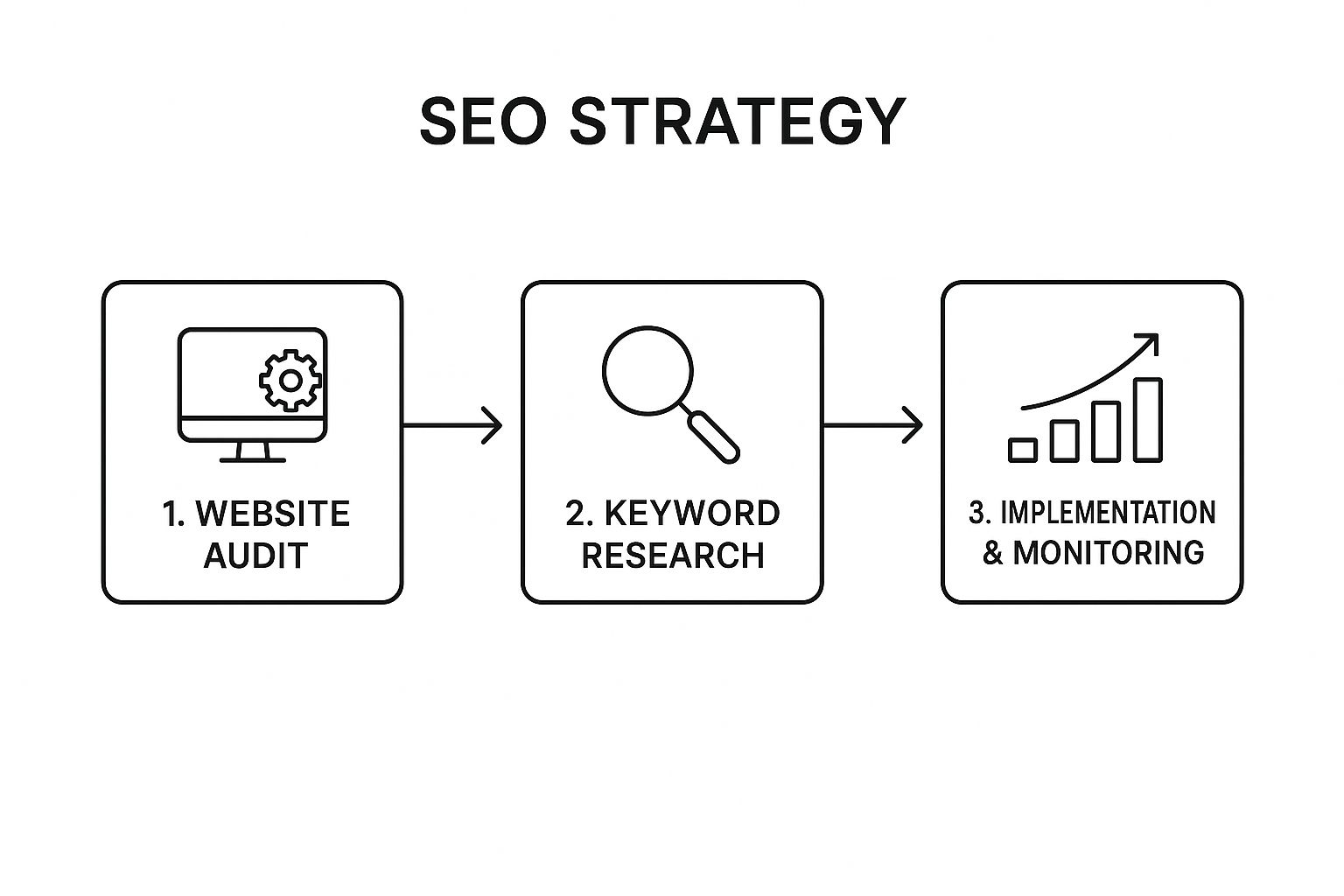
Ultimately, a winning strategy is a continuous cycle. You audit, research, implement, monitor, and then repeat. It’s an ongoing process of refinement that delivers compound growth over time.
Uncovering Competitor Insights and Keywords
Some of the best strategic breakthroughs you’ll ever have are hiding right under your nose—on your competitor’s websites.
A huge part of building a winning SEO strategy is putting on your detective hat and doing a little digital espionage.
By seeing what your rivals are doing well (and where they’re dropping the ball), you can find some massive opportunities for your own growth.
But here’s a crucial distinction: your direct business competitors aren’t always your true organic search rivals. The companies you fight for customers with might be totally different from the websites you’re wrestling with for keyword rankings on Google. The first job is to figure out who you’re really up against in the SERPs.

This shot from a keyword tool perfectly illustrates how a single “seed” keyword can explode into thousands of related queries. Each one tells a different story with its own search volume, intent, and difficulty.
Digging into these related terms is how you move past the obvious, high-competition keywords and find the long-tail gold that signals stronger buying intent.
Pinpointing Your True SEO Competitors
To get started, drop your domain into a tool like Semrush or Ahrefs. They’ll spit out a report of “Organic Competitors,” which are other domains that rank for a lot of the same keywords you do.
Don’t be surprised if this list includes industry blogs, news sites, or even niche forums alongside the businesses you already know. These are the players you need to watch.
Once you have this list, it’s time to dissect their strategies. I like to focus on a few key areas to pull out actionable intelligence:
- Top Performing Pages: Find out which of their pages are pulling in the most organic traffic. Are they product pages? Long-form guides? Comparison articles? This tells you exactly what kind of content is clicking with your shared audience.
- Content Gaps: Where are they crushing it, and where are they weak? A content gap analysis will show you keywords your competitors rank for that you don’t even touch. This is a goldmine for content ideas that already have proven demand.
- Backlink Profiles: Take a peek at who is linking to them. High-quality links are a massive ranking factor, so seeing which authoritative sites are referencing your competition can give you a target list for your own outreach and digital PR.
This isn’t just a one-and-done task.
For more ideas on how to consistently find new content angles and stay ahead, check out the marketing insights on our blog.
Building a High-Intent Keyword Universe
Armed with competitor insights, you can shift to much smarter keyword research.
The goal here isn’t just to find keywords with the highest search volume. It’s to find the ones with the right search intent.
You need to attract people who are actively looking for the solutions you offer, not just kicking tires.
The most valuable keywords are rarely the most popular ones.
A long-tail keyword like “best project management software for small creative agencies” might only get 50 searches a month, but it will convert at a much higher rate than a broad term like “project management” with 50,000 searches.
Intent-driven keyword research is all about understanding the why behind the search. We usually break intent down into four main types:
- Informational: The user wants to learn something (“how to improve team productivity”).
- Navigational: The user is looking for a specific site (“Asana login”).
- Commercial: The user is doing their homework before buying (“Asana vs Trello”).
- Transactional: The user is ready to pull out their credit card (“Asana business plan pricing”).
A solid keyword strategy needs a healthy mix of these, but your commercial and transactional terms—the ones that align directly with your products or services—should be your top priority.
Organizing Keywords into Topic Clusters
Modern SEO has moved way beyond just targeting individual keywords on separate pages.
The smart approach is to organize your keywords into topic clusters.
This model works by creating a central, authoritative “pillar page” on a broad topic. Then, you surround it with “cluster content”—smaller articles that dive deep into specific subtopics.
For example, your pillar page might target “Content Marketing Strategy.”
The cluster content would then go after more specific, long-tail keywords like “how to create a content calendar,” “measuring content marketing ROI,” or “B2B content distribution channels.”
Every piece of cluster content links back to the main pillar page.
This sends a powerful signal to Google that you have deep expertise on the entire subject, improving your chances of ranking for those big-ticket terms and establishing your site as an authority in your space.
Crafting Content That Ranks and Converts

Alright, you’ve done the legwork and have a solid list of competitor-vetted keywords.
Now for the fun part: turning those keywords into content that actually does something for your business.
This is where the rubber meets the road.
Simply pumping out blog posts for every keyword on your list is a classic rookie mistake, and it’s a surefire way to waste time and money.
The real secret is creating content with a clear purpose—content meticulously designed to meet a user’s needs at a specific point in their journey with your brand.
It’s not enough to know what people are searching for.
You have to understand the why behind their search.
A winning content plan maps each keyword to a stage in the buyer’s journey, ensuring you have the right asset to attract new visitors, engage prospects, and, ultimately, guide them toward becoming a customer.
Mapping Keywords to the Buyer’s Journey
Think of your customer’s path as a simple three-stage funnel. Your content needs to show up and provide value at every single step, moving people from “just browsing” to “ready to buy.”
- Awareness Stage (Top of the Funnel): These folks are just starting out. They have a problem and are looking for answers, education, or general insights. Their searches often look like questions, such as “how to improve team productivity.” Your job here is to attract a wide net of potential customers with genuinely helpful, informative content—think blog posts, ultimate guides, and shareable infographics.
- Consideration Stage (Middle of the Funnel): At this point, they’ve defined their problem and are actively researching solutions. Keywords get more specific, like “best project management software” or “Asana vs Trello comparison.” This is your chance to position your brand as the best solution with in-depth comparison articles, expert guides, and compelling case studies.
- Decision Stage (Bottom of the Funnel): The user is ready to pull the trigger. Their searches are highly commercial and often include brand names, like “Asana pricing” or “Visibility Ventures SEO services.” Content at this stage needs to be persuasive and direct. We’re talking service pages, detailed feature breakdowns, and demo or free trial offers.
When you map your keywords this way, every piece of content you create serves a distinct business goal. You’re no longer just writing for Google; you’re building a system that nurtures leads from initial curiosity to a final conversion.
Choosing the Right Content Types
A blog post can’t do the job of a service page, and a case study won’t attract top-of-funnel traffic.
Different stages of the journey—and different user intents—demand different content formats.
A great example of this is the pillar page and cluster model.
You create one massive, comprehensive “pillar page” on a broad topic like “digital marketing.”
This page acts as the central hub and establishes your authority.
Then, you support it with shorter, more focused “cluster” blog posts on subtopics like “email marketing tips” or “social media advertising,” all linking back to that main pillar. It’s a powerful structure that users and search engines both love.
Here are a few workhorse content types and where they fit in:
- Pillar Pages: Foundational guides covering a core topic from A to Z. Perfect for building topic authority.
- Blog Posts: Targeted articles that answer a very specific question. Your go-to for attracting top-of-funnel traffic.
- Case Studies: Real-world stories showing exactly how you helped a customer win. Incredibly persuasive for middle-of-funnel prospects.
- Comparison Pages: Head-to-head, honest comparisons between your product and a competitor’s. A must-have for capturing decision-stage searchers.
Your goal should always be to provide “information gain.”
This simply means giving the reader something unique they can’t find on the other nine pages ranking for that keyword.
This could be original data, a unique perspective from your own experience, or just a more logical, user-friendly layout.
Executing High-Authority Content
Creating content that actually stands out requires more than just good writing.
It has to be built on a foundation of genuine authority and trust, with the user’s intent as your north star.
A 2025 survey from Conductor found that 91% of marketing managers saw a positive impact on their website metrics from SEO last year alone, proving that a well-executed content plan is non-negotiable.
To make sure every piece you publish pulls its weight, you need to nail these fundamentals:
- Make it Scannable: Use clear, descriptive headings (H2s, H3s), short paragraphs, and bullet points. People rarely read word-for-word online; they scan. Make it easy for them.
- Add Compelling Visuals: Break up your text with high-quality images, custom graphics, screenshots, or even short videos. They make complex points easier to understand and keep readers engaged.
- Provide Genuine Value: This is the big one. Infuse your content with real-world examples, actionable tips, and insights drawn from your own experience. This is what builds credibility and turns a casual reader into a loyal fan.
By combining smart keyword mapping with a relentless focus on quality, your content becomes more than just a tool to rank.
It becomes a business asset that drives traffic, builds trust, and generates real results. To see how we build strategies like this, you can learn more about our dedicated content marketing services.
Optimizing Your On-Page and Technical SEO
Even the most brilliant content strategy will fall flat if your website’s technical health is poor.
I like to think of a website as a house. The content is your beautiful furniture and decor, but the technical and on-page SEO is the actual foundation, the plumbing, and the electrical wiring. If those aren’t solid, nobody’s going to stick around to admire the paint color.
Getting these elements right is non-negotiable. This is how you ensure search engines can actually crawl, understand, and properly index your pages, which is the only way your content gets a fair shot at ranking in front of the right people.
Mastering the On-Page Fundamentals
On-page SEO is all about optimizing the individual pages on your site. The good news? You have direct control over these elements, making them a great place to score some quick wins. Even small, thoughtful changes here can send powerful relevance signals to Google.
For every important page you publish or update, run through this mental checklist:
- Title Tags: This is your headline in the search results. It absolutely must contain your target keyword and be compelling enough to make someone want to click. Keep it under 60 characters to avoid it getting cut off.
- Meta Descriptions: Think of this as your ad copy for the search results page. While it’s not a direct ranking factor, a good one can dramatically improve your click-through rate by summarizing the page’s value.
- Header Tags (H1, H2, H3): Headers give your content structure, making it easier for both humans and search engine bots to read. Your H1 is your main headline (use your primary keyword), and H2s and H3s should break down subtopics in a logical way.
- Internal Linking: This one is huge. Linking to other relevant pages on your own website is how you show Google the relationship between your content. It also helps users discover more of your great content, keeping them on your site longer.
Optimizing these basics is all about creating clarity. You’re explicitly telling Google, “Hey, this page is about this specific topic, and here’s why it’s a valuable result.”
Essential On-Page SEO Checklist
To make this even more practical, I’ve put together a checklist. Use this table to audit your most critical pages and make sure you haven’t missed any opportunities to signal relevance and quality to search engines.
| Element | Best Practice | Impact Level |
|---|---|---|
| URL Slug | Short, descriptive, and includes the primary keyword. Example: /on-page-seo-checklist. | High |
| Title Tag | Under 60 characters, features the primary keyword near the beginning, and is compelling. | High |
| Meta Description | Under 160 characters, includes the keyword, and provides a clear benefit to the user. | Medium |
| H1 Tag | One per page. Contains the primary keyword and matches the page’s main topic. | High |
| Subheadings | Use H2s and H3s to logically structure content and include related keywords. | Medium |
| Image Alt Text | Descriptive text for all images that includes relevant keywords for context. | Medium |
| Internal Links | Add 2-3 links to other relevant, authoritative pages on your own website. | High |
| Keyword Usage | Include the primary keyword naturally in the first 100 words and throughout the content. | High |
Running through this checklist for every new piece of content is a simple habit that pays off significantly over time. It ensures you’re building a consistently optimized site, page by page.
Don’t Neglect Your Technical Foundation
Technical SEO is all the work you do behind the scenes to make sure your site is fast, secure, and easy for search engines to crawl. It can feel a bit daunting, but ignoring it can completely sabotage your content efforts.
A slow, broken, or confusing website is a deal-breaker. Google’s entire business model is based on giving its users a good experience. It simply will not rank a site that frustrates visitors, no matter how amazing the content is.
You don’t need to be a developer to focus on the technical areas that move the needle most:
- Site Speed: We’ve all abandoned a slow-loading page. In SEO, speed is everything. Aim for a load time under three seconds. Tools like Google PageSpeed Insights are a great starting point for finding out what’s slowing you down.
- Mobile-First Indexing: This isn’t a “nice-to-have” anymore. Google now primarily uses the mobile version of your site for indexing and ranking. Your website must look and work flawlessly on a smartphone. No excuses.
- Structured Data (Schema Markup): This is a bit of code you add to your site to give search engines more context about your content. It’s what powers those “rich snippets” in search results, like star ratings, event times, or FAQ dropdowns. They make your listing stand out and can seriously boost click-through rates.
If you want to dig deeper into fixing these common issues, our guide to improving your technical SEO is a great place to start.
Even as search algorithms get more complex, these foundational principles are more critical than ever. With Google holding around 89.62% of the search market and organic search driving about 53.3% of all website traffic, getting this stuff right is not optional. You can find more data on the continued relevance of SEO on WeAreTG.com.
Measuring Performance and Refining Your Strategy
An SEO strategy isn’t a static document you create, file away, and forget. Think of it more as a living, breathing roadmap that needs constant attention.
Hitting ‘publish’ on new content or optimizing your pages is really just the starting line. The real work—and the real results—come from consistently executing, tracking your progress, and refining your approach along the way.
Without a solid plan for execution, even the most brilliant strategy will just collect digital dust.
A simple content calendar is your best friend here. It turns your big-picture goals into a concrete schedule, making sure your team is regularly publishing content, building links, and chipping away at technical fixes. It’s the engine that keeps everything moving forward.
But putting in the work is only half the battle. You have to know what’s working and, just as importantly, what isn’t. That means focusing on the metrics that actually move the needle for the business.
Identifying KPIs That Actually Matter
It’s incredibly easy to get lost in a sea of data.
I’ve seen teams chase vanity metrics like keyword rankings for low-value terms or fixate on their overall domain authority score.
It feels productive, but those numbers often have zero connection to actual business results. A huge part of building a successful SEO strategy is learning to filter out that noise.
The key is to tie your Key Performance Indicators (KPIs) directly back to the business goals you defined from the get-go.
- Organic Traffic Growth: Don’t just look at the total number. Is traffic to your most important service or product pages going up? That’s a far more powerful signal of success.
- Conversion Rate from Organic Search: Are visitors from Google actually doing what you want them to do, like requesting a demo or buying a product? This is the ultimate test of your content’s real-world value.
- Share of Voice (SoV): This metric shows you how visible you are for your core set of keywords compared to your main competitors. When your SoV increases, you know you’re becoming a more dominant voice in your space.
- Keyword Portfolio Growth: Track the number of high-intent, commercially valuable keywords you’re ranking for on the first page. This is a great indicator that your topical authority is expanding in all the right places.
When you focus on these outcome-driven metrics, you can have much more meaningful conversations about the real impact your SEO efforts are having.
Your Essential SEO Monitoring Toolkit
You don’t need a dozen expensive subscriptions to track these KPIs effectively. In fact, two free platforms from Google itself will give you the vast majority of the data you’ll ever need.
- Google Search Console (GSC): This is your direct line of communication with Google. It’s invaluable for seeing how you’re performing for specific keywords, spotting technical hiccups like crawl errors, and understanding which pages are earning the most clicks and impressions.
- Google Analytics 4 (GA4): This is where you see what people do after they arrive on your site. GA4 is absolutely essential for tracking organic traffic trends, seeing how users engage with your content, and, most importantly, measuring conversions.
Here’s a quick look at a standard GA4 dashboard, which helps you visualize where your traffic is coming from and how users are behaving.

This kind of report shows you, at a glance, how different channels like organic search are contributing to your site’s traffic and engagement over time.
The Cycle of Analysis and Refinement
Your SEO strategy should operate on a continuous feedback loop: implement, measure, analyze, and refine. This agile approach lets you react to algorithm updates, shifts in competitor tactics, and new opportunities as they pop up.
A great strategy isn’t about being right from the start; it’s about being willing to pivot based on what the data tells you. If a content cluster isn’t gaining traction after six months, don’t be afraid to re-evaluate the keywords or completely change the format.
Make time every single month to sit down and review your core KPIs. Ask yourself some tough questions based on what you find:
- What Worked? Pinpoint the top-performing content or optimizations from the last month. Is there a pattern you can replicate?
- What Didn’t Work? Which pages are underperforming or losing traffic? Dive into GSC to see if impressions have dropped or if the click-through rates are tanking.
- What Are the New Opportunities? Fire up your competitor analysis tools. Are your rivals ranking for new keywords you could be targeting?
This regular process of analysis and adjustment is what separates a static plan from a dynamic, results-driven SEO machine. It keeps your efforts laser-focused on your business goals, paving the way for sustainable, long-term organic growth.
Got Questions About SEO Strategy? We’ve Got Answers
Even with the best plan in hand, you’re going to have questions as you start building out your SEO strategy. That’s completely normal. SEO has a ton of moving parts, and it’s natural to wonder about things like timelines, budgets, and what all the jargon actually means.
Let’s tackle some of the most common questions I hear from people just starting out. Getting straight answers to these will give you the confidence to move forward and execute your plan well.
How Long Does It Really Take to See SEO Results?
This is the big one, isn’t it? The honest, no-fluff answer is: it depends. SEO is a long game, not a quick hack. While you might see some small wins from technical fixes or on-page updates in a few weeks, you should realistically plan for 4 to 12 months to see meaningful, lasting growth in your traffic and rankings.
Several things can speed this up or slow it down:
How Tough Your Niche Is: Trying to rank for “local bakery in Austin” is a completely different ballgame than going after “best project management software.” The more crowded your field, the more patience you’ll need.
Your Starting Point: A well-established website with a solid history and some good backlinks will see results much faster than a brand-new domain starting from zero.
Your Commitment: SEO rewards consistency. If you’re regularly publishing great content and building links, those efforts will compound and accelerate your results over time.
Patience is probably the most underrated skill in SEO. The strategies that win are the ones you stick with for months, not just for a few weeks when you’re feeling motivated.
What’s the Difference Between On-Page, Off-Page, and Technical SEO?
I like to think of these as the three legs of a stool. If one is weak or missing, the whole thing falls over. Your strategy needs all three to be stable and effective.
On-Page SEO: This is everything you can control on the actual pages of your website. We’re talking about the quality of your content, your title tags, the way you link between your own pages, and your headline structure. It’s all about making your content as clear and relevant as possible for both users and search engines.
Off-Page SEO: This involves all the actions you take off your website to build its reputation and authority. The biggest piece of this puzzle is earning high-quality backlinks from other trusted sites in your industry.
Technical SEO: This is the nuts and bolts—the foundation of your site. It’s about making sure search engines can find, crawl, and understand your website without any trouble. This covers crucial things like site speed, mobile-friendliness, and clean code.
Can I Do SEO on a Small Budget?
Yes, you absolutely can. A tight budget isn’t a dealbreaker; it just means you have to be smarter and more focused with your efforts. You can’t afford to waste time on things that don’t move the needle, so you’re forced to prioritize what really counts.
With limited funds, you’ll want to lean into tasks that require more of your time than your money. Focus on creating genuinely helpful content that targets less competitive, long-tail keywords. You can also master the fundamentals of on-page and technical SEO yourself, as these are often about effort, not expensive tools. For link building, forget costly services and instead dedicate your time to manual outreach and building real relationships.
Ready to build a data-driven SEO strategy that delivers measurable growth? At Visibility Ventures, we combine expert insights with a proven process to boost your organic traffic and revenue. Get your free, no-obligation SEO audit report today and uncover the opportunities waiting for your business.