


Growing your e-commerce sales isn’t about finding a single magic bullet.
It’s a methodical process, a discipline, really.
The secret lies in weaving together a few key areas: making your site a joy to use, getting found by the right people on Google, running sharp marketing campaigns, and then using data to do it all better next time.
When you get these four pieces working in harmony, you build something powerful—a reliable engine for bringing in more revenue.
Building Your Foundation for Sales Growth

Before you even think about ramping up ad spend or launching a massive new campaign, you have to look at your foundation.
Pumping money into a website that leaks customers is just a fast way to waste a budget.
The real key to learning how to boost ecommerce sales for the long haul is building a solid, multi-channel system where every part supports the others.
This guide is our playbook for doing just that.
We’re going to skip the fluffy, generic advice and get straight to the practical steps that actually move the needle on your bottom line.
These aren’t just isolated tactics; they’re the core components of a growth machine.
The Core Pillars of Ecommerce Success
Think of your growth strategy like a structure supported by four pillars.
If one is weak, the whole thing becomes unstable.
You need to give each one the attention it deserves.
To get a clearer picture, let’s break down these essential areas.
Core Pillars for Ecommerce Sales Growth
| Strategic Pillar | Primary Goal | Essential First Action |
|---|---|---|
| UX & CRO | Turn more visitors into buyers by making shopping easy and intuitive. | Conduct a user-testing session to watch real people try to buy a product. |
| SEO | Attract high-quality traffic from people actively looking for your products. | Perform keyword research to understand the exact phrases customers are searching for. |
| Marketing Channels | Reach the right customers on the right platforms with a compelling message. | Define your ideal customer persona to focus your marketing efforts. |
| Data & Analytics | Use performance data to make smart, informed decisions for continuous growth. | Set up conversion tracking in Google Analytics 4 to measure what’s working. |
Each pillar plays a critical role.
A great user experience won’t matter if no one can find your site, and amazing traffic from SEO is useless if your checkout process is a nightmare.
They all have to work together.
The opportunity here is massive. Global e-commerce retail sales are projected to hit $7.4 trillion by 2025.
Grabbing your slice of that pie requires a focused, well-executed strategy, not just wishful thinking.
Ultimately, a systematic approach is what separates the brands that struggle from the ones that scale. T
he strategies we’ll cover are the same ones we use to drive serious revenue growth for our clients, which you can see in our e-commerce case studies.
By following this playbook, you stop hoping for more sales and start building a system that delivers them.
Turning Your Storefront into a Conversion Machine

Think of your website as your #1 salesperson.
It never sleeps, never takes a day off, and it’s your biggest opportunity to turn casual browsers into loyal customers.
To really move the needle on sales, you have to treat it that way, which means getting serious about User Experience (UX) and Conversion Rate Optimization (CRO).
The whole idea is to make the shopping experience feel so smooth and intuitive that customers barely have to think.
Every click should feel right, pages should snap into view, and buttons should take them exactly where they expect.
It’s the little moments of friction—a slow-loading page, a confusing menu—that quietly kill your sales.
Crafting an Effortless User Journey
When was the last time you abandoned a shopping cart? I’m willing to bet it was because the site was a pain to use.
Maybe it was slow, or you just couldn’t find what you were looking for.
Those are classic UX fails, and they have a direct, painful impact on your bottom line.
Let’s start with your navigation.
Can a brand-new visitor find your best-selling product category in five seconds or less? This is where clarity trumps creativity.
Use simple, direct labels like “Women’s Hiking Boots” instead of vague, branded terms.
A logical site structure and a powerful search bar are non-negotiable.
Now, let’s zoom in on your product pages.
This is your digital showroom, and it needs to do more than just list a price.
- Show, Don’t Just Tell: Pack your pages with high-quality photos from every angle, videos of the product in action, and even 360-degree views.
- Write Descriptions that Sell: Don’t just list the specs. Weave a narrative. Explain how this product solves a real-world problem or makes someone’s life better. This is also where good SEO really shines, as it helps you pull in the right kind of traffic from the start.
- Make the CTA Obvious: Your “Add to Cart” button should be the most eye-catching thing on the page. Use a bold, contrasting color that pops.
The secret ingredient here is trust. People are naturally hesitant to buy from a store they don’t know. Social proof is your single best tool for overcoming that skepticism.
It’s just how we shop now—we want to see what others think first.
A staggering 99% of customers read reviews before buying, which makes displaying authentic testimonials and star ratings absolutely critical.
Optimizing for Mobile and Checkout
Let’s be real: most of your customers are shopping on their phones.
If your site isn’t a dream to use on a small screen, you’re leaving a ton of money on the table. Think big, tappable buttons, simple forms, and a design that doesn’t require any awkward pinching or zooming.
Finally, you have to obsess over your checkout. This is the final step, and it’s where an incredible number of potential sales just vanish.
- Kill the Clutter: Only ask for the information you absolutely need. Every single extra field you make someone fill out is another reason for them to give up.
- Let Them Check Out as a Guest: Forcing someone to create an account is one of the biggest conversion killers in e-commerce. Always, always offer a guest checkout option.
- Show Them It’s Safe: Display security badges (like McAfee or Norton) and the logos of payment methods you accept. These small visual cues go a long way in reassuring customers their data is secure.
By relentlessly hunting down and eliminating these points of friction, you transform your website from a simple catalog into a finely tuned engine built for one purpose: turning visitors into happy, paying customers.
Driving High-Intent Traffic with Smart SEO

You can pour a ton of money into creating a beautiful website with a slick user experience, but it means absolutely nothing if the right people never find it.
The real secret to learning how to boost ecommerce sales isn’t just about getting more traffic; it’s about attracting shoppers who are actively hunting for what you sell.
This is where a smart Search Engine Optimization (SEO) strategy becomes your single most powerful tool for growth.
We’re not talking about old-school keyword stuffing.
Modern e-commerce SEO is all about understanding what your customers are really looking for and building a site that both people and search engines can’t help but love.
It’s the difference between getting a random visitor and a customer who lands on your product page, credit card in hand.
Uncovering What Customers Really Want
Every solid SEO effort is built on keyword research, but I don’t mean just grabbing a list of high-volume terms.
You have to get inside your customer’s head. What problem are they trying to solve? What specific features do they need?
Think about their journey. Someone searching for “best running shoes” is in a totally different headspace than someone searching for “Brooks Ghost 15 women’s size 8.” The first person is browsing; the second is buying. Your job is to show up for both.
- Informational Keywords: These are perfect for your blog. A post like “How to Choose the Right Hiking Boot for Your Trip” catches potential customers when they’re just starting their research.
- Commercial Keywords: Target these on your category pages. Think “women’s waterproof hiking boots” or “lightweight camping tents.”
- Transactional Keywords: This is where the money is. Optimize your product pages for those super-specific, long-tail searches like “buy North Face Recon backpack black.”
When you map your content this way, you provide value at every single step. You’re building trust and guiding people from a casual question to a confident purchase.
By aligning your content with specific search intent, you stop chasing vanity traffic and start attracting visitors who are significantly more likely to convert into paying customers.
Optimizing Your Digital Storefront
Once you know what your customers are searching for, you need to dial in your on-page optimization.
This goes way beyond just sprinkling a few keywords in your product titles.
Your product pages are your most valuable SEO real estate.
You absolutely have to craft unique, compelling descriptions for every single item.
Please, don’t just copy and paste the manufacturer’s blurb—that’s a fast track to duplicate content penalties. Instead, write copy that actually sells, highlighting the real-world benefits and answering common questions before they even pop into a customer’s head.
Your category pages are just as important for catching those broader commercial searches.
These pages shouldn’t just be a lifeless grid of products.
Add a helpful introductory paragraph right at the top. Use your target keywords naturally and explain what makes your selection of products special.
This simple tweak provides critical context for search engines and vastly improves the experience for your shoppers.
If you want to dive deeper, you can find more advanced strategies in our comprehensive guide to ecommerce SEO services.
Mastering the Technical Details
Finally, let’s talk about the foundation. The technical health of your website is what holds up all your other SEO efforts. If your site is slow, a nightmare to use on a phone, or confusing for Google to crawl, you’ll never rank well—no matter how brilliant your content is.
Keep your focus locked on these three technical pillars:
- Site Speed: Every second—no, every millisecond—counts. A slow site kills conversions and sends your bounce rate through the roof. Compress your images, use a content delivery network (CDN), and get your code as lean as possible so pages load in a blink.
- Mobile Experience: It’s no secret that most online shopping now happens on phones. Your site must be fully responsive. That means big, easy-to-tap buttons and a checkout process so smooth you could do it with one hand while holding a coffee.
- Structured Data (Schema Markup): This is a bit of code you add to your site that gives search engines extra information about your pages. For e-commerce, this is gold. You can use it to get things like star ratings, price, and stock status to show up right in the search results, making your listings impossible to ignore.
Launching Marketing Campaigns That Convert
So, you’ve built a beautiful website and nailed your SEO.
That’s a huge win, but it’s only half the battle. You can’t just build it and expect them to come.
To really boost ecommerce sales, you need to get proactive and meet your customers where they are.
This isn’t about just throwing ads at a wall and seeing what sticks.
It’s about building a smart, multi-channel engine where email, social media, and paid search all work together.
The goal is to create a seamless experience that guides people from discovery right through to checkout.
Nurturing Customers with Email Automation
I’m always telling clients that their email list is gold.
Unlike your social media followers, you own your email list.
It’s your direct line to your most engaged audience, perfect for nurturing leads and encouraging repeat business.
The real magic happens with automation and segmentation.
Forget sending the same generic newsletter to everyone. You can set up automated email “flows” that trigger based on what a customer actually does.
Here are a few essential flows I recommend for every store:
- The Welcome Series: When someone new signs up, don’t just hit them with a coupon. Send a series of 3-4 emails that tell your brand story, show off your best-sellers, and explain what makes you different from the competition.
- Abandoned Cart Reminders: This one is non-negotiable. A simple, friendly email an hour after someone ditches a full cart can recover a surprising amount of lost revenue. I’ve seen a follow-up 24 hours later, maybe with a small incentive, work wonders.
- Post-Purchase Follow-ups: The relationship doesn’t end when the credit card is charged. This is your chance to ask for a review, offer care tips for their new product, or even suggest complementary items they might love.
The real power move is segmentation.
By grouping your audience based on what they’ve bought or even just looked at, you can send incredibly relevant offers.
Someone who just bought hiking boots from you? Send them an email about waterproof socks, not stilettos.
This kind of personalization makes people feel seen, and it absolutely crushes conversion rates.
And when you ask for those reviews via email, the impact is huge. This data shows just how critical social proof is for key sales metrics.
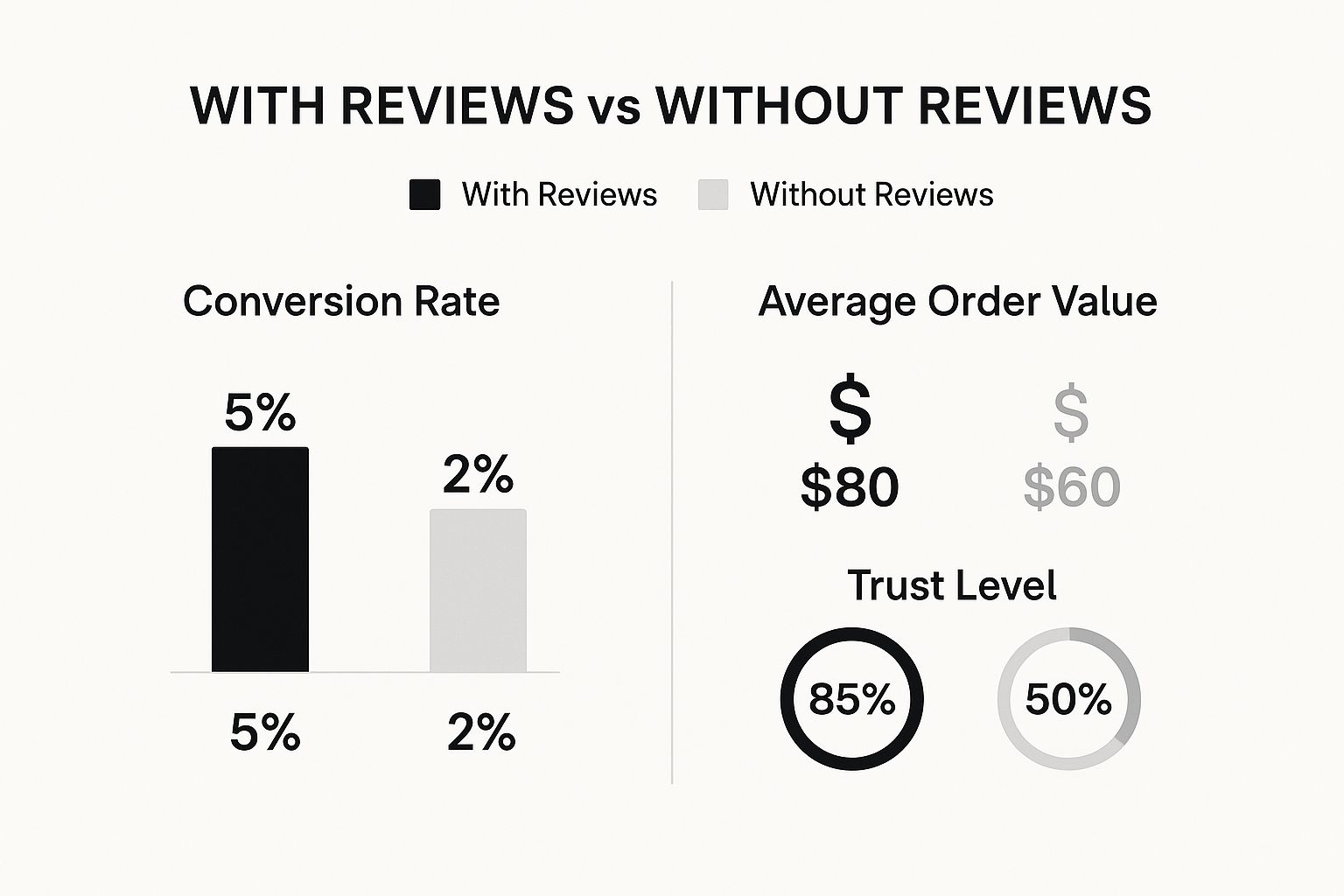
As you can see, just having reviews can more than double your conversion rate while also boosting trust and the average amount people spend.
Turning Social Media into a Sales Channel
Social media isn’t just a billboard for your brand anymore; it’s a full-blown sales channel.
Platforms like Instagram and Facebook have built impressive social commerce tools that let people discover and buy your products without ever leaving the app.
The key is to create “shoppable” content.
Use high-quality lifestyle photos and videos that show your products being used in the real world.
From there, you can tag every single product in your posts and stories, creating a super smooth path from inspiration to purchase.
Paid social ads let you get even more specific.
My favorite tactic is retargeting. You can show ads for the exact product someone viewed on your site just a few hours ago.
It’s a simple, powerful way to jog their memory and bring them back to finish the purchase.
Weaving a compelling story with your visuals is a cornerstone of any effective content marketing strategy for ecommerce.
Capturing High-Intent Buyers with Paid Search
While social ads are fantastic for creating demand, paid search (PPC) is all about capturing it.
This is your tool for getting in front of people who have their wallets out, ready to buy.
Think about it. When someone types “buy women’s waterproof running shoes” into Google, they aren’t just browsing.
They have a problem and they’re actively looking for the solution.
By running targeted Google Shopping and search ads, you can put your products right at the very top of the results for these money-making keywords. It’s like having a direct pipeline to your most motivated customers.
Marketing Channel Strategy Comparison
Choosing the right channels can feel overwhelming. This table breaks down the core strengths and use cases for the big three we’ve discussed, helping you align your strategy with your specific goals.
| Channel | Best For | Primary KPIs |
|---|---|---|
| Email Marketing | Nurturing leads, driving repeat purchases, building loyalty. | Open Rate, Click-Through Rate (CTR), Conversion Rate, Unsubscribe Rate |
| Social Media | Brand awareness, community building, product discovery, top-of-funnel engagement. | Engagement Rate, Reach, Follower Growth, Social-to-Site Conversions |
| Paid Search (PPC) | Capturing high-intent buyers, driving immediate sales, bottom-of-funnel conversions. | Cost Per Click (CPC), Conversion Rate, Return on Ad Spend (ROAS) |
Ultimately, a strong marketing plan doesn’t rely on a single channel.
The most successful brands create an integrated system where each channel supports the others, creating a powerful and consistent customer journey.
The global e-commerce market is set to hit an astonishing $6.88 trillion by 2025, and there are over 28 million businesses fighting for a slice of that pie.
Standing out requires a smart, integrated marketing approach where every channel works in harmony to tell your brand’s story and guide customers to your store.
Using Data to Fuel Continuous Growth
Your gut feeling as a store owner is a powerful asset, but it can only take you so far. To build a truly resilient and growing business, you have to move beyond guessing and start making smart, data-backed decisions. The raw numbers are your best source of truth, showing you exactly how shoppers behave and where your biggest opportunities are hiding.
This is the shift from reacting to sales dips to proactively building a system for improvement. You’re creating a feedback loop where every click, every purchase, and every abandoned cart informs your next strategic move.
Pinpointing Your Key Growth Levers
Before you can start fixing things, you need to know what’s broken. Diving headfirst into a tool like Google Analytics 4 without a clear plan is a recipe for overwhelm. Instead, zero in on the handful of metrics that directly tie to your revenue.
These are the big three—your business’s vital signs:
- Conversion Rate: Simple and powerful. What percentage of visitors actually buy something? This is the ultimate scorecard for your site’s overall performance.
- Average Order Value (AOV): How much does a customer typically spend at one time? Bumping this number up is often a much faster way to grow revenue than just pouring more money into ads to get new traffic.
- Customer Lifetime Value (CLV): What’s the total revenue you can expect from a single customer over their entire relationship with your brand? This metric tells you if you’re building a loyal following or just a leaky bucket of one-time buyers.
Tracking these three gives you a quick, high-level health check. If your conversion rate is tanking, something on your site is probably causing friction. If AOV is flat, it might be time to get serious about upselling, cross-selling, or product bundling.
Your sales funnel isn’t a mystery. Analytics can light up the exact spots where customers are giving up, turning a vague feeling that “something’s wrong” into a specific, fixable problem.
Imagine you see a huge number of people adding items to their cart but never actually starting the checkout process. That’s not just a random event; it’s a massive clue. The problem is likely on your cart page. Maybe it’s a surprise shipping cost that appears too late or a confusing “Proceed to Checkout” button. Without the data, you’d be left guessing.
Turning Insights into Actionable Strategies
Once you’ve used data to spot a problem or an opportunity, you can make targeted changes. Let’s say you discover that visitors who spend time on your “About Us” page have a 25% higher AOV. That’s a fascinating insight. The action? Start weaving your brand story into your homepage, product descriptions, and email marketing.
This is also where real personalization kicks in. By looking at a customer’s purchase history, you can stop blasting them with generic product recommendations. If someone only ever buys dark roast coffee beans, your next email to them should feature a new single-origin dark roast you just got in—not a random ad for green tea.
It’s this attention to detail, fueled by data, that turns first-time shoppers into lifelong fans and creates a repeatable cycle of growth you can actually count on.
Common Questions About Boosting Ecommerce Sales
When you’re trying to figure out how to actually move the needle on your sales, a lot of questions pop up. We’ve walked through some heavy-hitting strategies, but making them work in the real world is all about handling the details. Let’s tackle a few of the most common questions I hear from store owners.
Where Do I Even Start?
This is probably the biggest one. With a dozen different things you could be doing across SEO, user experience, and marketing, it’s easy to get paralyzed. The best advice I can give is to start with your data.
Get into your analytics and hunt for the biggest leak in your sales funnel. Is your cart abandonment rate through the roof? That’s a clear signal to fix your checkout process. If you have decent traffic but a terrible conversion rate, your product pages or site navigation might be the problem. Low traffic but people who do show up are buying? Go all-in on SEO and marketing to get more qualified visitors.
Don’t try to boil the ocean. Find the one thing that’s costing you the most money right now and focus all your energy there. Nail that one fix, and let that win build momentum for the next one.
This keeps you from spreading your budget and time too thin, making sure every move you make has a real, measurable impact on your revenue.
How Quickly Can I Expect to See Results?
Ah, the million-dollar question. The honest answer is, it completely depends on what you’re doing. Some tactics are built for speed, while others are a long-term investment.
Quick Wins (Days to Weeks): Things like paid ads (PPC) or a well-timed email campaign—especially an abandoned cart series—can show a sales lift almost right away. Running a flash sale or adding a strategic upsell offer during checkout can also inject cash flow within a few days.
Long-Term Growth (Months): SEO is a marathon, not a sprint. You’re typically looking at 3-6 months before you start seeing significant, sustained traffic growth from a new SEO push. It takes time to build authority with search engines. Building a powerful brand and a loyal social media following also falls into this slower, more foundational category.
If you want to dig deeper into specific tactics, the Visibility Ventures blog has a ton of articles that break down both quick-win and long-haul growth strategies.
What’s the Most Overlooked Growth Opportunity?
So many store owners get tunnel vision on acquiring new customers. They spend all their time and money trying to attract strangers while completely ignoring the goldmine they’re already sitting on: their existing customer base.
Think about it. It’s always easier and far less expensive to get a happy customer to buy from you again than it is to convince a new person to trust you for the first time.
Put some serious effort into your post-purchase experience.
Launch a simple loyalty program.
Send personalized follow-up emails with recommendations based on what they just bought.
Create exclusive offers just for repeat buyers.
This isn’t just about boosting Customer Lifetime Value (CLV); it’s how you turn satisfied shoppers into vocal brand advocates who do your marketing for you.