


Getting your content to show up in Google AI Overviews is a whole new ballgame. It’s less about old-school SEO tactics and more about creating incredibly clear, authoritative, and well-structured content that gives people—and Google’s AI—exactly what they’re looking for.
Success here comes down to nailing your E-E-A-T signals, matching search intent with laser precision, and formatting your content so it’s a breeze for machines to read. Get that right, and your page becomes the perfect source for those AI-generated summaries.
The New SEO Frontier of Google AI Overviews

The search results page is going through its biggest shake-up in a decade.
Google AI Overviews aren’t some far-off experiment anymore; they’re here, and they’re fundamentally changing how people find information.
If you want your brand to stay visible, you need to understand this new frontier.
These AI-powered summaries sit right at the top of the search results, offering up concise answers pulled from multiple web pages. Think of them as a supercharged featured snippet, weaving together info from several trusted sources to give users a comprehensive first look. This is a massive shift from how we’ve thought about ranking in the past.
How AI Overviews Actually Work
When someone types in a query, Google’s AI models figure out the intent behind it and scan the web for the most reliable content that hits the mark. The system then cherry-picks key information from an average of five different sources and stitches it into a coherent summary, citing each source with a link.
This all happens in real-time, which means the content in an AI Overview can change from one search to the next.
The growth of this feature has been explosive.
As of March 2025, AI Overviews were popping up in 13.14% of all Google searches. That’s a huge jump from just 6.49% in January 2025 and shows just how serious Google is about integrating AI into search.
What’s really interesting is that while 52% of the cited sources also rank on the first page organically, a good chunk of them come from pages ranking further down. This opens up a massive opportunity for high-quality content that might not have otherwise seen the light of day.
The One-Two Punch of Getting Cited
Landing a spot in an AI Overview gives you a powerful advantage. First, the obvious one: your website gets top billing on the SERP, positioning your brand as an authority before a user even starts to scroll. That’s prime real estate.
But there’s a second, more subtle benefit. Google’s internal systems, like Navboost, are always watching user engagement. When someone clicks your link from an AI Overview and has a good experience on your site, it sends a powerful quality signal back to Google.
This positive feedback can actually boost your traditional organic rankings over time. It creates a powerful cycle where your authority just keeps building on itself. This is why having a solid SEO is more critical than ever.
Key Takeaway: Ranking in AI Overviews isn’t just about a one-time placement. It’s about using that top-tier visibility to build lasting authority and trust with both users and Google’s algorithms.
What This Means for Your SEO Strategy
Adapting to this new reality doesn’t mean throwing out everything you know about SEO. It means sharpening your approach. The core principles of creating great content still apply, but the focus has shifted.
Here’s a quick look at how things are changing.
Key Differences Traditional SEO vs AI Overview SEO
| Factor | Traditional SEO Focus | AI Overview SEO Focus |
|---|---|---|
| Content Goal | Comprehensive topic coverage, keyword density, and long-form articles. | Direct answers, clear structure, and factual accuracy. |
| Authority Signals | Primarily backlinks, domain age, and overall site authority. | E-E-A-T signals, author expertise, and reputable outbound links. |
| Formatting | Optimized for readability with H2s, H3s, and images. | Heavily relies on lists, tables, and short, scannable paragraphs. |
| Keywords | Targeting primary and secondary keywords for organic ranking. | Focusing on conversational, long-tail queries and question-based keywords. |
Ultimately, the game has changed. Your goal is now to create content that is so clear, helpful, and trustworthy that Google’s AI sees it as an essential source for summarizing a topic for its users.
Crafting Content That AI Overviews Trust

If you want your content to show up in Google’s AI Overviews, you need to structure it for a machine to understand without making it sound robotic for your human readers. It’s a bit of a balancing act, but nailing it is how you become a go-to source for AI-generated summaries. Forget keyword stuffing or old-school tricks; this is all about clarity.
The big idea is to make your content so straightforward that an AI can instantly see the main points, check the facts, and pull direct answers. This means shifting away from long, winding narratives and embracing a more modular, answer-focused way of writing.
Adopt The Answer-First Method
The quickest way to get an AI’s attention is with the answer-first method. This is exactly what it sounds like: you directly answer the user’s main question in the first couple of sentences, right below your headline. No more burying the lead with a fluffy introduction.
For example, if someone asks, “What is the best temperature for brewing green tea?” an AI-friendly article would kick off with: “The ideal temperature for brewing green tea is between 160-180°F (70-82°C). Sticking to this range prevents bitterness and brings out the tea’s best flavors.”
This technique basically mimics the format of a featured snippet. It gives the AI a clean, self-contained answer it can easily grab and cite. Once you’ve done that, you can dive deeper into the “why” and “how.”
Structure Your Content Like A Q&A
Think of your article’s structure as a conversation. Your headings and subheadings (H2s and H3s) should pose the questions your audience is asking, and the paragraphs that follow should deliver the answers. This approach turns your content into a well-organized FAQ for that topic.
- H2: “How to Choose the Right Coffee Beans”
- H3: “What Is the Difference Between Arabica and Robusta?”
- H3: “Does Roast Level Affect Caffeine Content?”
This isn’t just about making the page easier for people to read. It creates a clear, logical hierarchy that AI crawlers can follow, making it simple for them to connect specific information to relevant queries. This is a core part of good on-page SEO that’s become even more critical now.
Embrace Scannable Formatting
AI models, just like busy people, prefer content that’s easy to scan. Long walls of text are a huge turn-off. Instead, you need to break up your information into bite-sized chunks using formatting that creates visual clarity.
One study found that lists appear in a whopping 78% of AI Overviews. That’s a massive signal that Google’s systems are drawn to structured, itemized information.
Pro Tip: Don’t just list words. Use descriptive bullet points that make sense on their own. Instead of writing “Speed, cost, quality,” try “High-speed performance ensures your tasks are completed quickly.”
Also, keep your paragraphs short—two or three sentences, max. This forces you to be concise and creates white space that makes the page feel less intimidating for both users and machines.
Become The Definitive Single-Source Resource
AI Overviews pull from multiple sources, but they absolutely favor content that is comprehensive and authoritative. Your goal should be to create a single page that covers a topic so thoroughly that the AI doesn’t need to hunt for extra details elsewhere.
This doesn’t mean you need to write a 10,000-word monster article. It just means anticipating and answering every related question a user might have. If you’re writing about “how to repot a plant,” you should also cover things like:
- When is the best time to repot?
- What kind of soil should I use?
- How do I choose the right size pot?
- What are the signs of transplant shock?
By building these comprehensive information hubs, you signal to Google that your page is the one-stop shop for that topic. This boosts your perceived authority and makes your content a much more attractive candidate for getting cited in an AI Overview.
Building Authority Signals for AI Recognition
Google’s AI is skeptical by design.
It’s not just hunting for a correct answer; it’s hunting for a correct answer from a source it actually trusts. If you want to show up in Google AI Overviews, you need to build strong authority signals that prove your content is credible, reliable, and written by someone who genuinely knows their stuff.
This is about more than just name-dropping E-E-A-T (Experience, Expertise, Authoritativeness, and Trustworthiness).
It’s about demonstrating those qualities with tangible elements on and off your page. Think of it as building a resume for your website that an AI can scan and immediately recognize as the real deal.
Showcase Your Expertise with Strong Author Signals
AI models are getting smarter about connecting content to the people who create it. An anonymous article or a generic corporate blog post just doesn’t carry the same weight as content tied to a real, verifiable expert. This is where a detailed author bio becomes an unexpectedly powerful SEO tool.
Your author bio needs to be more than a name and a title. It should clearly spell out the author’s credentials, relevant experience, and qualifications related to the topic at hand.
- Link to Credentials: Always include links to the author’s social profiles (especially LinkedIn), their personal website, or other publications where they’ve been featured.
- Highlight Real-World Experience: Don’t just say, “John is a marketing expert.” Instead, try: “John has over a decade of experience leading SEO strategies for SaaS companies, resulting in an average 150% organic traffic growth for his clients.” See the difference?
- Keep it Consistent: Use the exact same author information across all guest posts and platforms. This creates a clear, consistent digital footprint that helps the AI connect the dots.
Following these steps creates an undeniable trail of evidence that tells Google’s AI, “This content was written by a real person with demonstrable expertise in this specific field.”
Reinforce Trust with Outbound and Inbound Links
Links are the currency of the web, and for an AI, they function as votes of confidence.
Getting the right mix of outbound links (linking out to other sites) and inbound links (backlinks from others) is absolutely critical for building authority.
When you strategically link out to reputable, high-authority sources—think academic studies, government websites, or respected industry publications—you’re showing that you’ve done your homework.
It signals that your content is well-supported and grounded in fact, not just opinion.
At the same time, earning high-quality backlinks from other authoritative websites is probably the strongest signal of them all. When a trusted site links to your page, it’s essentially vouching for your credibility.
And remember, not all backlinks are created equal; a single link from a top-tier industry blog is worth far more than a hundred from low-quality directories.
Expert Insight: I like to think of backlinks as professional references on a resume. The more respected the reference, the more weight it carries. This tells an AI that other experts in your field consider your content a valuable resource worth citing.
This infographic breaks down a simple process for finding the right topics to build your authority on.
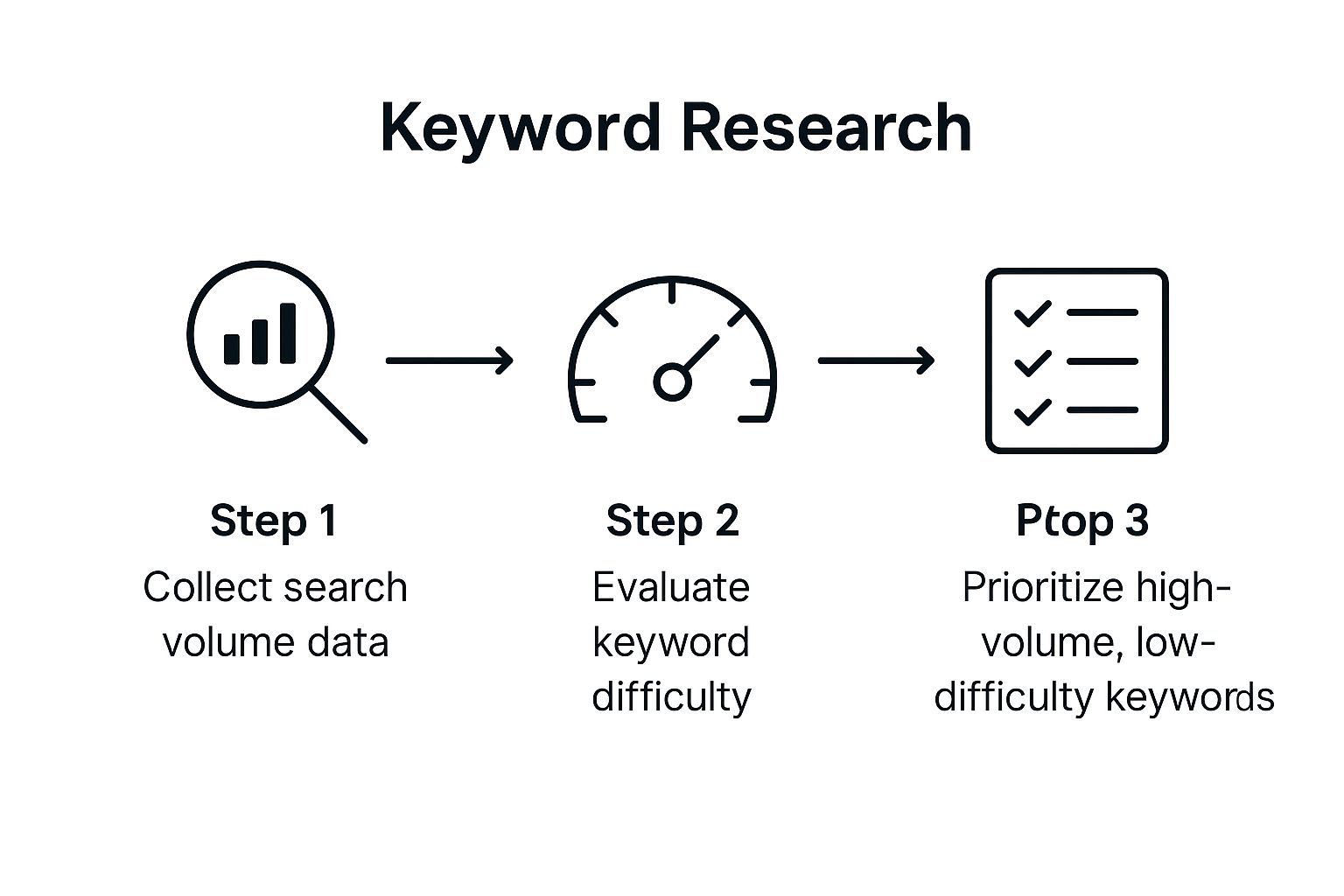
This visual guide really drives home the importance of balancing search volume with competitive difficulty to find those strategic content opportunities.
Translate Your Content for Machines with Structured Data
Structured data, also known as schema markup, is basically a universal language that helps search engines understand the context and purpose of your content without any guesswork. It’s like adding little labels to all your information so an AI can categorize it perfectly.
Implementing schema is a non-negotiable part of modern SEO. But for AI Overviews, certain types are especially powerful.
For example, using FAQPage schema on a page with a question-and-answer format explicitly tells Google, “Hey, this section has answers to common questions.” In the same way, HowTo schema is perfect for step-by-step guides, breaking down the process cleanly for the AI.
By structuring your content this way, you remove all ambiguity. You make it incredibly easy for Google to parse your page, identify key information, and confidently pull that info for an AI Overview. The proper use of structured data is a core part of any solid technical SEO approach, ensuring your site is communicating loud and clear with search crawlers.
Using AI Tools for Smarter AI SEO

To show up in Google’s AI Overviews, it helps to fight fire with fire. That means bringing AI tools into your own SEO workflow. This isn’t about letting robots take over; it’s about moving from tedious manual tasks to a more strategic role where you’re guiding the technology instead of getting buried in spreadsheets.
Think of these tools as incredibly powerful assistants. They can process huge amounts of data, spot patterns, and suggest optimizations at a scale that’s just not possible for a human. This frees you up to focus on the creative strategy and nuance that only a person can bring.
Uncovering AI-Friendly Keywords
Old-school keyword research often misses the conversational, long-tail questions that are prime real estate for AI Overviews. People are asking Google longer, more detailed questions, and your keyword strategy needs to catch up. This is exactly where AI tools excel.
They can sift through thousands of forum threads, “People Also Ask” boxes, and competitor content to pinpoint the exact phrases your audience uses. Instead of just targeting a broad term like “best running shoes,” an AI tool might surface “what are the best running shoes for flat feet with plantar fasciitis?” That’s a query practically begging for an AI Overview.
This gives you a direct line into your user’s head, letting you build content that perfectly matches their very specific needs.
Generating AI-Ready Content Outlines
Once you’ve got your target queries, building a content structure that Google’s AI can easily understand is your next move. Manually creating a comprehensive outline that covers every single angle can take hours, if not days. AI content optimization tools can draft a detailed, logical outline in minutes.
These tools aren’t just guessing. They analyze the top-ranking pages and existing AI Overviews for your query to figure out:
- Essential Subtopics: What themes and questions show up again and again?
- Structural Patterns: Do the top sources use lists, tables, or a Q&A format?
- Semantic Terms: What related concepts and entities do you need to mention to prove your expertise?
You end up with a data-driven blueprint for your article, ensuring you cover the topic more thoroughly than the competition. Building out this kind of in-depth content is a pillar of any modern content marketing strategy designed for the new age of search.
Expert Insight: The best AI-generated outlines are a starting point, not the final product. Use them to make sure you’ve covered all your bases, then inject your own expertise, stories, and brand voice to make the content uniquely yours.
Analyzing and Outperforming Competitors
Ever looked at an AI Overview and wondered why a competitor’s page was cited instead of yours? AI tools can deconstruct their success for you. Just plug a competitor’s URL into an analysis tool, and you can get an instant breakdown of their on-page strategy.
This kind of analysis can reveal subtle but critical details—like their specific use of structured data, the density of certain keywords, or the clarity of their answer-first formatting. This intel is gold. It lets you spot gaps in your own content and make data-backed improvements instead of just guessing what might work.
Using these technologies isn’t a fringe practice anymore. As of 2025, a massive 86% of SEO professionals have integrated AI into their strategies. On top of that, 75% of marketers say they use AI to cut down on manual tasks, which helps them create content faster—a huge advantage when AI Overviews often favor the freshest information.
By bringing these tools into your process, you’re not just keeping up. You’re building a smarter, more efficient workflow that gives you a real competitive edge in the race for AI Overview visibility.
How to Track and Adapt Your AI Overview Strategy
Getting your content cited in an AI Overview isn’t a “set it and forget it” kind of win. Think of it as an ongoing conversation with Google’s algorithm. The search world changes fast, and what gets you featured today might not work tomorrow.
To stay in the game, you need a solid feedback loop. You have to know which pages are getting picked up, for what kinds of searches, and what you can learn from those wins to do it again. Without that data, you’re just flying blind.
Identifying Your AI Overview Footprint
First things first, you need to figure out if and where you’re already showing up. The big SEO platforms are still catching up with dedicated AI Overview tracking, but you can get a surprisingly clear picture by piecing together data from existing tools and a little bit of manual detective work.
Your first stop should be Google Search Console (GSC). While it doesn’t have a neat “AI Overview” filter just yet, you can hunt for clues. Keep an eye on pages with tons of impressions but a suspiciously low click-through rate (CTR) for certain queries. This is often a tell-tale sign that your content is being used to answer a question right on the results page, so users don’t need to click through.
Next, lean on your rank tracking tools. Most of the major players now include SERP feature tracking that will flag when an AI Overview is present for your target keywords. This is gold. It helps you see which topics in your niche are most likely to trigger an AI-generated answer, so you can focus your efforts where they’ll have the most impact.
And finally, don’t underestimate the power of a simple, targeted manual search. Pop open an incognito browser and regularly check your most important keywords. This old-school approach gives you the most immediate and unfiltered view of how you’re performing.
Analyzing What Works and Why
Okay, so you’ve found a few pages that are getting cited. Don’t just pop the champagne and move on—it’s time to put on your detective hat and dissect that success. Your goal here is to figure out the specific ingredients that made your content so appealing to the AI.
For every page that gets a citation, ask yourself these questions:
- What kind of search was it? Was the query informational (“how to fix a leaky faucet”), navigational (“acme plumbing”), or commercial (“best plumber near me”)?
- How was the content formatted? Did you use a numbered list? A clean Q&A format? Or maybe a super-concise definition right at the top? Research shows that lists appear in a whopping 78% of AI Overviews, which is a pretty strong hint about what the algorithm likes to see.
- How was the answer structured? Was it a direct, factual statement? Did you lead with the “answer-first” method, getting straight to the point?
By spotting these patterns, you can start building a repeatable playbook. For example, if you see that your “how-to” articles get cited every time you use a numbered list, you’ve just found a clear-cut action item: go apply that structure to your other procedural content.
Key Takeaway: Your successes are your best teachers. Each time you’re cited in an AI Overview, it’s a clue from Google about what its AI values. Systematically deconstruct these wins to build a data-driven content strategy.
Iterating and Scaling Your Success
With these insights in your back pocket, you can start refining your larger content strategy. This isn’t about tearing down your entire site and starting from scratch. It’s about making smart, incremental improvements and scaling what you already know is working.
Start by making a priority list of existing content that targets keywords you know trigger AI Overviews. Now, go back and retrofit these pages with the successful formats and structures you’ve identified. That might mean rewriting an intro to be more direct, adding a structured FAQ section with schema, or just breaking up a wall of text into easy-to-scan bullet points.
This iterative process transforms content optimization from a guessing game into a methodical, data-backed system. By constantly tracking your footprint, analyzing your wins, and adapting your strategy, you build a powerful engine for consistently earning that coveted spot in Google’s AI Overviews.
Common Questions About AI Overviews
As you’d expect, this whole shift to AI-driven search brings up a lot of questions. For SEOs and business owners trying to get their footing, a few key concerns pop up again and again. Let’s clear the air and give you some straight answers.
We’ll tackle the common myths and give you a real-world take on what actually matters when you’re figuring out how to show up in Google’s AI Overviews.
Do I Need to Rank on Page One to Get Featured?
Nope, not at all. And honestly, this is one of the biggest opportunities on the table right now. While some studies show that about 52% of sources in an AI Overview also have a top-10 organic spot, that leaves a massive chunk of real estate open for everyone else.
In fact, some data even suggests that nearly 80% of citations can come from sources outside of that traditional first page. This is huge. It means a well-structured, authoritative article can effectively leapfrog competitors who might have a stronger backlink profile but murkier, less direct content.
Key Insight: Your ability to provide the best, most direct answer is starting to outweigh raw domain authority. Focus on clarity and structure first.
Will AI Overviews Decrease My Website Clicks?
This is the million-dollar question, isn’t it? It’s tied directly to the old fear of “zero-click searches.” And while it’s true that an AI Overview might answer a user’s question right on the SERP, it’s definitely not a guaranteed traffic killer. Think bigger picture: getting cited boosts your brand’s visibility and instantly positions you as a trusted source.
For any topic with real complexity, users will almost always click through for more detail. Plus, there’s a strong theory that Google’s internal systems, like Navboost, will reward cited pages with better organic rankings over time, leading to more traffic in the long run.
Your job is to write content that encourages that click by hinting at the deeper value your full article provides. For more ideas on content strategy, feel free to check out our other posts on the Visibility Ventures blog.
What Is the Most Important Ranking Factor?
There’s no single magic bullet here. Getting featured comes from a combination of strong signals. But if I had to pin it down to one thing, it would be creating clear, factually accurate content that directly answers a specific question.
This content absolutely must be well-structured with proper headings, lists, and short paragraphs. It also needs to be backed up by solid E-E-A-T signals, like detailed author bios and links out to other reputable sources that support your claims.
Think of it this way: your job is to make it as easy as possible for an AI to understand, verify, and summarize your content. If you can nail that, you’re already halfway to earning a citation.