


Long-tail keywords are critical for driving targeted traffic, improving conversions, and ranking for less competitive search terms. Over 70% of search queries are long-tail, and they convert 2.5x better than broad keywords. Specialized tools simplify finding these keywords, helping you refine your SEO strategy and attract niche audiences.
Here’s a quick overview of the top 5 tools for long-tail keyword research:
- Semrush: Offers extensive keyword data, advanced filters, and competitive insights. Ideal for professionals managing large-scale SEO campaigns.
- Ahrefs Keywords Explorer: Features a massive keyword database, competitor analysis, and real-time updates. Great for mid-size businesses.
- Long Tail Pro: Focuses on long-tail keywords with affordability and simplicity. Perfect for niche marketers and affiliates.
- KeySearch: Budget-friendly with easy-to-use filters and SEO tools. Best for beginners and small businesses.
- Google Keyword Planner: Free tool with reliable Google data. Suited for startups and those on tight budgets.
Each tool has unique strengths, from vast databases to affordability, catering to different needs and expertise levels.
Quick Comparison of Long Tail Keyword Research Tools
| Tool | Starting Price (USD) | Database Size | Best For | Limitations |
|---|---|---|---|---|
| Semrush | $119.95/month | 26+ billion keywords | Agencies, enterprise users | Higher cost, steep learning curve |
| Ahrefs Explorer | $99/month | 28.7 billion keywords | Mid-size businesses | Credit-based pricing |
| Long Tail Pro | $25/month | Moderate coverage | Niche/affiliate marketers | Fewer advanced features |
| KeySearch | $24/month | 1+ billion keywords | Beginners, small businesses | Smaller database |
| Google Keyword Planner | Free | Google’s search data | Startups, budget-conscious | Lacks advanced features |
Finding the right tool depends on your goals, budget, and technical expertise. Read on to explore each tool in detail and decide which fits your needs best.
1. SEMrush

Semrush stands out as a go-to tool for discovering long-tail keywords, thanks to its robust suite of research features. The Keyword Magic Tool is at the heart of this process, generating thousands of keyword suggestions in just seconds based on your seed keyword [2]. Let’s dive into how Semrush leverages its extensive resources to shape an effective long-tail keyword strategy.
Keyword Database Size and Depth
Semrush boasts an enormous keyword database, offering a wealth of information on diverse search terms. It provides key metrics like search volume, keyword difficulty (KD), search intent, and cost-per-click (CPC) data [2][3]. This depth is particularly helpful for pinpointing question-based long-tail keywords – a crucial area as voice search and conversational queries continue to grow.
Advanced Filtering for Long-Tail Keywords
One of Semrush’s standout features is its advanced filtering system.
The Keyword Magic Tool allows you to filter results by word count (focusing on three or more words), keyword difficulty, search volume, and even question-based queries using its “Questions” filter [1][2][3].
Additionally, you can easily identify low-competition opportunities by selecting the “Easy” option in the “KD %” dropdown menu [2].
Additional Tools for Competitive Insights
Semrush doesn’t stop at keyword suggestions. Tools like Keyword Gap and Organic Research provide deeper insights into competitor strategies and niche opportunities. The Keyword Gap tool helps identify long-tail keywords your competitors are ranking for [2].
You can refine results further by focusing on low search volume, easier keyword difficulty, and competitor rankings within the top 20 positions.
Meanwhile, the Organic Research tool uncovers keywords that niche forums and related websites rank for, offering valuable conversational and question-based keyword ideas [2].
The Keyword Overview Tool also lets you review essential metrics, ensuring your chosen keywords have real potential [2].
Pricing and Subscription Options
Semrush offers tiered subscription plans to accommodate different needs and budgets, ranging from beginner-friendly options to enterprise-level solutions. While it’s pricier than free tools, the breadth of features and data accuracy often make it a worthwhile investment for dedicated SEO professionals. Plus, free trials are available, allowing you to explore its long-tail keyword capabilities before committing.
2. Ahrefs Keywords Explorer
Ahrefs Keywords Explorer is a robust tool designed to help you uncover long-tail keyword opportunities. By tapping into its extensive database and advanced features, you can identify low-competition, high-potential keywords that align with your goals.
Keyword Database Size and Updates
Ahrefs boasts a massive database of 28.7 billion keywords, including 2.4 billion specific to the US market [7]. This wealth of data ensures you have plenty of local search information to work with. With a daily crawl of over eight billion web pages and a 15-trillion link database, Ahrefs provides a highly accurate snapshot of search trends [8].
The platform refreshes its keyword database every 15 minutes, ensuring that you’re always working with the most up-to-date data [8]. This frequent updating is especially useful for spotting new long-tail keyword trends in dynamic industries.
Tools for Long-Tail Keyword Research
Ahrefs simplifies the process of finding long-tail keywords through three key reports: Matching terms, Related terms, and Search suggestions [5].
- Matching terms: Offers variations of your seed keyword.
- Related terms: Highlights semantically connected phrases that users might search for.
- Search suggestions: Provides real-world query data from search engines, giving you authentic long-tail options.
The Keyword Difficulty (KD) metric is another standout feature. Long-tail keywords often have lower competition, and the KD score lets you filter for terms that match your domain’s authority. This makes it easier to pinpoint keywords you can realistically rank for.
Advanced Features for Competitive Insights
Ahrefs goes beyond keyword suggestions by offering a SERP overview that provides a detailed look at top-ranking pages for any keyword [5]. This includes key metrics like domain ratings, backlinks, and traffic estimates, helping you assess the competition and refine your content strategy.
Another advantage is the platform’s extensive backlink database [8]. This data allows you to evaluate the competitive landscape for specific keywords, giving you a clearer picture of what it will take to rank effectively in your niche.
For those looking for free tools, Ahrefs’ keyword generator taps into a pool of 8 billion keywords, offering valuable insights even without a paid subscription [6].
3. Long Tail Pro
Long Tail Pro combines a targeted approach with affordability to help users uncover highly specific keyword opportunities. Designed for finding long-tail keywords (phrases with four or more words), this tool offers a clean, easy-to-navigate interface that caters to both beginners and seasoned marketers alike [9].
Keyword Database Size and Depth
Long Tail Pro pulls its keyword data directly from Google, ensuring the information is fresh and relevant [9]. While it doesn’t maintain its own massive proprietary database, this method focuses on delivering reliable, up-to-date insights.
The tool shines when it comes to identifying long-tail keywords, which are crucial given that 92.42% of Google searches have a monthly search volume of 0-10 [10].
It provides an array of helpful metrics for each keyword, including monthly search volumes, suggested bids, and advertiser competition levels. Additionally, Long Tail Pro calculates an aggregate difficulty score for keywords, making it easier to build topic clusters and uncover less competitive opportunities [11].
Pricing and Affordability
One of the standout features of Long Tail Pro is its affordability, making it a popular choice for budget-conscious users [12]. It offers three pricing plans:
- Starter Plan: $25/month (billed annually) or $207.90/year with a 30% discount, tracking up to 30 keywords.
- Pro Plan: $45/month (billed annually) or $375.90/year with a 30% discount, tracking up to 200 keywords.
- Agency Plan: $98/month (billed annually) or $823.90/year with a 30% discount, tracking up to 1,000 keywords.
All plans include a 7-day free trial and a 10-day money-back guarantee for the Starter and Pro plans [12]. The Agency plan supports up to 5 simultaneous logins, while the Pro and Starter plans allow 2 and 1 login(s), respectively [12]. By focusing on longer, niche-specific keywords, Long Tail Pro helps users effectively tap into less competitive search traffic.
Ease of Filtering for Long-Tail Keywords
Long Tail Pro’s advanced filtering tools make it easier to zero in on the best long-tail keywords. The “Num Words” filter, for instance, allows users to target phrases with four or more words [11]. Additional filters include monthly search volume, suggested bid amounts, and advertiser competition levels. The tool’s Keyword Competitiveness (KC) score is particularly useful for identifying manageable opportunities – keywords with a KC score between 0-30 are often the most achievable [11].
Additional Features
Beyond keyword research, Long Tail Pro includes tools for competitive analysis and keyword difficulty scoring [11]. Its straightforward interface ensures that users can access powerful features without feeling overwhelmed [9]. For anyone looking to discover effective long-tail keywords without breaking the bank, Long Tail Pro offers an excellent balance of functionality and cost-efficiency./banner/inline/?id=sbb-itb-d46ea71
4. KeySearch
KeySearch stands out as an affordable and precise tool for long-tail keyword research, earning a stellar 4.9/5 rating from over 10,000 users. It’s particularly popular among bloggers, small businesses, and SEO agencies for its balance of cost and functionality, making it a go-to option for those seeking effective keyword strategies without breaking the bank [16].
Keyword Database Size and Depth
KeySearch taps into a massive database of over a billion keywords, offering users a robust platform for long-tail keyword discovery. By combining its internal database with suggestions from search engines like Google Suggest and Bing Suggest, it uncovers a wealth of keyword opportunities [13].
“With Keysearch we can find even more keywords using other suggestion engines like Google Suggest, Bing Suggest, the Keysearch Database with over 1 Billion keywords, etc… Just follow the same steps and you’ll have loads of easy-to-rank profitable keywords. Happy keyword hunting!”
– Dan, Keysearch CEO at Keysearch [13]
Long-tail keywords are especially valuable, as they account for 77.91% of organic conversions and drive 82.53% of a website’s organic traffic. KeySearch’s ability to pinpoint these keywords gives users a significant edge in generating traffic and conversions [14].
Pricing and Affordability
KeySearch offers flexible pricing plans designed to meet a variety of needs while maintaining access to essential SEO features:
- Starter Plan: $24/month or $240/year (17% savings). Includes 200 keyword searches daily, 80 tracked keywords monthly, 2,000 audited pages monthly, and 5,000 AI credits [15].
- Pro Plan: $48/month or $480/year (17% savings). Adds the Foresight feature, 500 keyword searches daily, 200 tracked keywords monthly, 5,000 audited pages monthly, and 15,000 AI credits [15].
Both plans include a 7-day free trial, and users can save an additional 20% with the code KSDISC [15].
“Switching to KeySearch from a more expensive tool is saving me over $1,000 per year! KeySearch has just what I need (without a ton of extra features I won’t use) and it’s really simple to use too. Love it!”
– Niche Pursuits [16]
Ease of Filtering for Long-Tail Keywords
KeySearch simplifies the process of identifying profitable long-tail keywords with its advanced filtering options:
- Search Volume Filtering: Focus on keywords with sufficient traffic potential by excluding those with search volumes below 100 [13].
- Difficulty Score Filtering: Zero in on easier-to-rank keywords by removing those with difficulty scores above 35 [13].
This targeted approach helps users find the ideal balance of traffic potential and competition, maximizing their return on investment [14].
Additional Features
Beyond keyword research, KeySearch includes a suite of SEO tools like competitor analysis, rank tracking, and site auditing. Its keyword difficulty calculator further aids in selecting the best terms to target, making it a comprehensive solution for businesses looking to improve their online visibility.
“KeySearch is an awesome, affordable keyword research tool for bloggers or businesses on a budget who want to leverage SEO data to drive more traffic to their blogs and websites.”
– Nina Clapperton, sheknowsseo [16]
Up next, we’ll dive into Google Keyword Planner for broader keyword insights.
5. Google Keyword Planner [FREE]
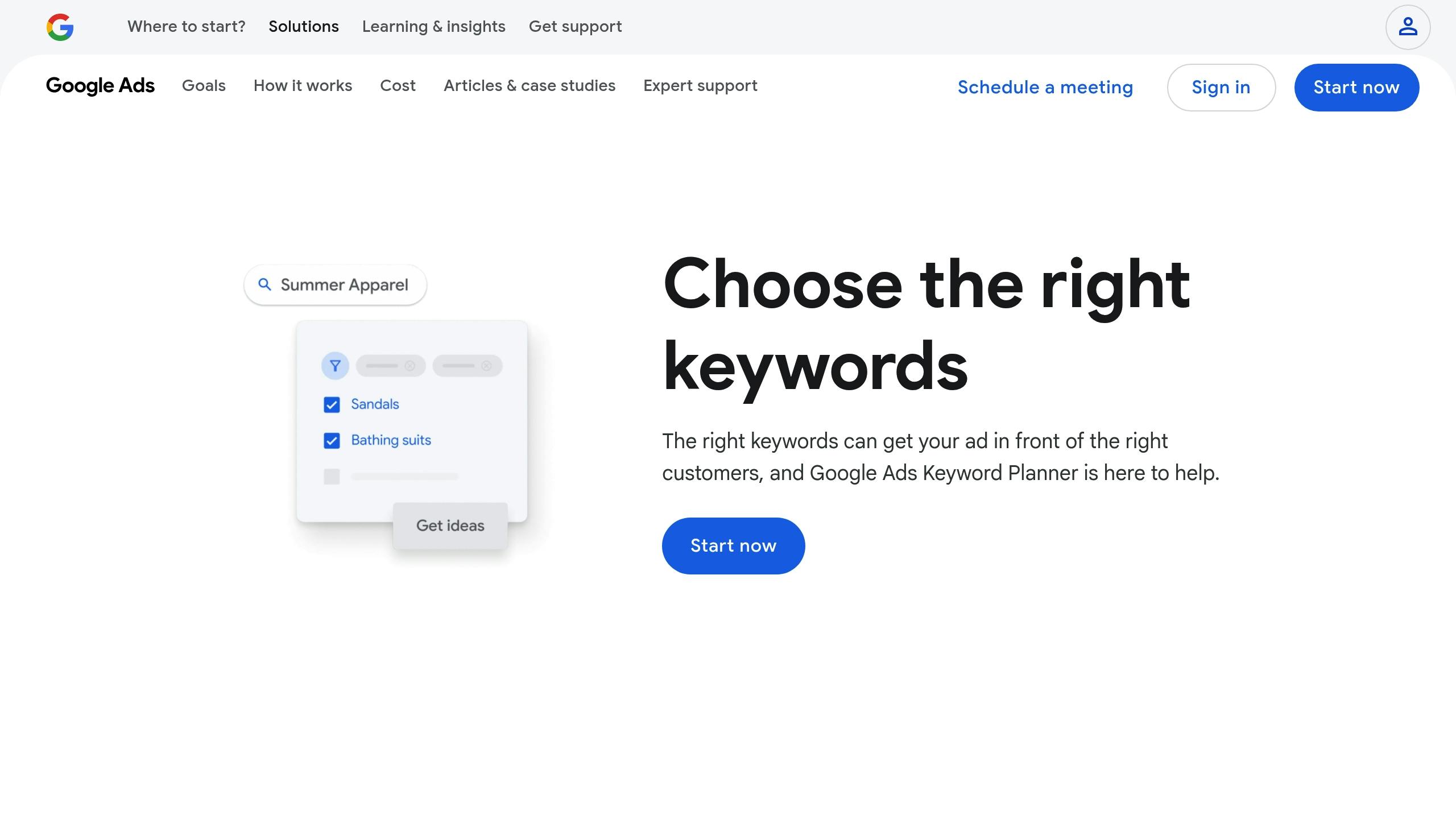
Google Keyword Planner stands out as the only completely free tool on this list, making it a go-to option for marketers and small businesses on a tight budget. As Google’s official keyword research tool, it provides data directly from Google’s search engine, ensuring reliable and trustworthy insights [19].
Pricing and Accessibility
The best part? Google Keyword Planner is entirely free. All you need is a Google Ads account to access its core features [20]. Even if you’re not running ad campaigns or spending money on ads, you can still use the tool without restrictions [20]. For startups, bloggers, or small businesses with limited resources, this is a game-changer.
That said, advertisers who actively run campaigns may get access to more detailed data, such as precise bid estimates. For non-advertisers, some of this information is shown as ranges [21]. Still, the fact that it’s free and taps into Google’s vast search database makes it a valuable resource.
Keyword Database and Suggestions
Since Google Keyword Planner pulls data directly from Google’s search engine, it offers keyword suggestions and search volume estimates that are as accurate as they come [19]. When you input seed keywords, the tool generates relevant long-tail variations, complete with search volume and competition metrics [17]. This direct integration ensures you’re working with up-to-date and reliable data.
Filtering for Long-Tail Keywords
If you’re looking for profitable long-tail keywords, Google Keyword Planner provides a range of filtering options to help you zero in on the best opportunities. You can refine results by search volume, competition levels, and even geographic targeting. For example, entering terms like “best running shoes”, “comfortable running shoes”, or “running shoes for beginners” can help uncover highly targeted keywords. These filters make it easier to identify long-tail keywords that align with your goals.
Features and Limitations
Beyond keyword suggestions, the tool also offers insights into search trends, volume patterns, and competition levels [17]. It’s especially useful for identifying keywords with strong commercial potential, making it ideal for both SEO and paid ad strategies [18].
However, the tool does have its drawbacks. For instance, it doesn’t provide keyword difficulty scores, a feature available in many specialized SEO tools [18]. Additionally, the results are static and don’t update daily, which can be a limitation for those needing real-time data [19]. The tool also doesn’t offer much in terms of exploring additional keyword variants beyond its initial suggestions [18].
For a more comprehensive keyword research process, many SEO professionals pair Google Keyword Planner with tools like Google Trends or Google Search Console [18]. While it might not offer every advanced feature, it’s an excellent starting point for understanding search volume and competition before diving into more specialized tools.
Tool Comparison Chart
Choosing the right SEO tool depends on your budget, expertise, and specific goals. Here’s a breakdown of key features for each tool to help you decide.
| Tool | Starting Price (USD) | Keyword Database Size | Key Strengths | Best For | Notable Limitations |
|---|---|---|---|---|---|
| Semrush | $119.95/month | 26+ billion keywords | Comprehensive toolkit, vast database, regular updates | Enterprise users, agencies, full-scale SEO campaigns | Steep learning curve, higher cost |
| Ahrefs Keywords Explorer | $99/month | Large database | User-friendly interface, competitor analysis, Parent Topic insights | Mid-size businesses, competitor research | Credit-based pricing, limited local SEO data |
| Long Tail Pro | $59.99/month | Moderate coverage | Specializes in long-tail keyword discovery | Niche and affiliate marketers | Fewer additional SEO features |
| KeySearch | $24/month | Good coverage | Beginner-friendly and affordable | Small businesses, SEO beginners | Smaller database compared to premium tools |
| Google Keyword Planner | Free | Direct Google data | Free access with official Google insights | Startups, budget-conscious marketers | Lacks keyword difficulty scores and advanced features |
Semrush stands out with its massive keyword database of over 26 billion keywords, making it ideal for identifying less competitive, highly targeted long-tail opportunities [22]. Its search volume estimates align with actual figures 32.4% of the time, outperforming other tools that average 20.7%, with only 1.8% of keywords missing [23]. This makes it a top choice for enterprise-level campaigns and agencies managing complex SEO strategies.
For those on a tighter budget, Google Keyword Planner offers free access to Google’s own data, providing reliable search volume insights. However, it lacks advanced features like keyword difficulty scores. KeySearch, priced at $24/month, is another budget-friendly option, known for its simplicity and ease of use – perfect for beginners and small businesses.
Meanwhile, Ahrefs is a favorite for mid-size businesses thanks to its intuitive interface and competitor analysis capabilities. It also provides valuable Parent Topic insights, which help users understand broader content opportunities. However, its credit-based pricing model and limited local SEO data might be a drawback for some.
Long Tail Pro caters specifically to niche and affiliate marketers, focusing on uncovering long-tail keywords. While it excels in this area, it offers fewer features compared to more comprehensive tools like Semrush and Ahrefs.
For beginners or budget-conscious marketers, Google Keyword Planner and KeySearch are excellent starting points. On the other hand, experienced users and agencies can benefit from the advanced features and extensive databases of Semrush and Ahrefs.
Interestingly, 92% of keywords get 10 or fewer monthly searches, underscoring the importance of tools with robust databases to uncover hidden opportunities that can boost traffic and conversions [4] [22]. Whether you’re a beginner or a seasoned marketer, there’s a tool to match your needs.
Conclusion
Long-tail keyword research plays a crucial role in achieving SEO success. With a striking 75% of searches falling under middle and long-tail queries and only 25% focusing on head terms, businesses that overlook these specific phrases risk missing out on the majority of search opportunities [24].
The numbers speak for themselves: long-tail keywords are 2.5 times more effective at driving conversions and are 36% more likely to convert than their shorter counterparts [24][25]. This shift, largely influenced by the rise of voice and conversational search, emphasizes the importance of targeting these niche queries.
Experts agree on this evolving trend:
“Long-tail keywords are becoming critical as search becomes more conversational with the advent of AI chat.” – Lem Park [26]
The tools mentioned earlier, ranging from free options like Google Keyword Planner to more advanced platforms like Semrush, cater to a variety of budgets and needs. For instance, beginners and small businesses might find user-friendly tools like KeySearch ideal, while agencies and larger organizations may require the advanced functionalities offered by Semrush or Ahrefs. Each tool provides distinct benefits to help uncover profitable long-tail keywords.
Considering that 92% of keywords receive 10 or fewer searches per month [4], the right tool can help you tap into these hidden opportunities. By targeting low-competition, high-intent keywords, businesses can build authority, attract relevant traffic, and ultimately boost conversions.
FAQs
Why do long-tail keywords lead to better conversion rates than broad keywords?
Long-tail keywords are a game changer when it comes to improving conversion rates. Why? Because they zero in on highly specific search queries. These are the kind of searches made by people who already know what they want – whether it’s buying a product, signing up for a service, or finding detailed answers.
What makes them even better is their ability to target niche topics. With less competition in search results, long-tail keywords give you a better shot at ranking higher. And it’s not just about visibility; the traffic they bring is laser-focused, meaning visitors are more likely to engage with your content and take action. Their accuracy makes them an excellent way to connect with audiences who are ready to act.
What should I look for in a long-tail keyword research tool for my business?
When choosing a tool for long-tail keyword research, focus on one that excels at identifying low-competition keywords with decent search volume. These keywords play a crucial role in attracting targeted visitors and strengthening your SEO efforts.
Look for features like autocomplete suggestions, question-focused keyword ideas, and competitor analysis to find niche opportunities. Additionally, consider the tool’s pricing, user-friendliness, and how seamlessly it integrates with your current SEO tools. This ensures it fits both your business objectives and budget.
A well-suited tool will streamline the process of uncovering keywords that connect with your audience and enhance your overall content strategy.
Why would a business choose a tool like Semrush instead of free options like Google Keyword Planner for long-tail keyword research?
Businesses often turn to Semrush instead of free tools like Google Keyword Planner because it offers a much broader range of features designed for in-depth keyword research and digital marketing.
With its enormous database of over 26 billion keywords, Semrush provides detailed insights into keyword difficulty, search trends, and competitive analysis that go beyond basic metrics.
What sets Semrush apart is its advanced functionalities. It doesn’t just stop at keyword research – it also includes tools for content optimization, competitor tracking, and developing marketing strategies. These features not only save time but also deliver actionable insights that free tools often miss. For businesses aiming to refine their long-tail keyword strategy and strengthen their SEO efforts, Semrush proves to be a powerful ally.